Global coal prices continued to strengthen over the past week as European coal gained support from low gas storage levels, while thermal and metallurgical markets in Asia-Pacific also moved higher.
Over the past week, the upward momentum in the coal market continued: the growing trend persisted in Europe; in China, Indonesia, and Australia, thermal coal prices rose; quotations for Australian metallurgical material bounced up.
The situation surrounding Iran, which is currently the main factor shaping the dynamics of the energy markets, remains unchanged. The expiration of the 60-day Memorandum of Understanding agreed by the US and Iran on August 17 brought no breakthroughs in negotiations between the countries.
President Trump stated that the naval blockade remains in full force. Meanwhile, Iran declared the sea route would remain closed until the US fulfills the terms of the interim agreement. On August 20, the US president announced the start of a large-scale economic war against Iran, simultaneously threatening sanctions against any country that supports Iran or does business with it.
European thermal coal indices rose above 127 USD/t. Low gas storage levels in Germany are boosting optimism in the coal market. German UGS facilities are 50% full, which is a low level, especially ahead of the winter heating season. Market participants point out that growing uncertainty over EU gas storage levels will likely lead to increased coal trading activity in the coming months as restocking demand on the continent intensifies.
German coal-fired power plant margins remained high this week amid rising electricity prices and lower renewable generation. Coal spreads rose to nearly 45.0 EUR/MWh, more than double last week’s level, while renewables’ share of German power generation stood at 57% (down from 69% w-o-w). Fossil fuels’ share was 43% (up from 31% w-o-w).
In the Netherlands, coal-fired power generation reached multi-year highs: average output since the start of the year stood at 1.29 GW — the highest level since 2022 (1.64 GW). Coal spreads for 49% efficiency coal plants have averaged 72.0 EUR/MWh this year, compared with 60.2 EUR/MWh in 2025. The country has increased coal generation to conserve natural gas stocks. Dutch UGS facilities are currently only 42% full, 20 ppts below last year’s level.
Gas quotations on the TTF hub rose over the week to 757.33 USD/1,000 m3 (+38.90 USD/1,000 m3 w-o-w). EU underground gas storage stood at 61.6% (+2.0 ppts w-o-w), 12.6 ppts below last year’s level of 74.2%.
South African High-CV 6,000 held above 109 USD/t. Demand from Indian sponge iron producers for South African material strengthened due to domestic supply disruptions, caused by monsoon rains, priority allocations to power plants and a rebound in sponge iron prices over the past two weeks.
In China, spot prices for 5,500 NAR coal at the port of Qinhuangdao remained virtually unchanged above 126 USD/t. The Chinese thermal coal market is seeing a widening gap between prices at mining sites and at ports. An intensifying wave of safety inspections and closures of washing plants, following a series of accidents have reduced supply and pushed up prices in mining regions.
However, cool and rainy weather due to Typhoon Dolphin in central and eastern industrial provinces is curbing power sector demand and reducing port activity. Demand from chemical producers at the mine level remains strong.
Coal stocks at 9 major ports rose to 26.77 mio t (+0.26 mio t w-o-w), while inventories at 6 major coastal thermal power plants stood at 14.02 mio t (+0.01 mio t w-o-w).
According to China’s National Climate Center, the El Nino phenomenon is developing rapidly and may peak around November-December. This introduces uncertainty into China’s coal demand outlook for the autumn-winter period and could lead to uneven consumption patterns across the country. The main risk, according to experts, lies in heightened regional disparities, driven by differences in rainfall, temperature and logistical disruptions across various parts of China.
Indonesian 5,900 GAR climbed above 105 USD/t, while the price of 4,200 GAR increased to 65.5 USD/t. Demand from China for Indonesian thermal coal remains strong, while supply from Indonesia continues to be pressured by uncertainty over RKAB production quota allocations.
Some Indonesian producers have received approval for additional mining quotas, though it remains unclear what part of additional volumes must be directed to Indonesia’s domestic market due to coal shortages at power plants that have caused blackouts in Kalimantan. Indonesia’s Ministry of Energy has not yet disclosed the total volume of additional quotas approved for 2026.
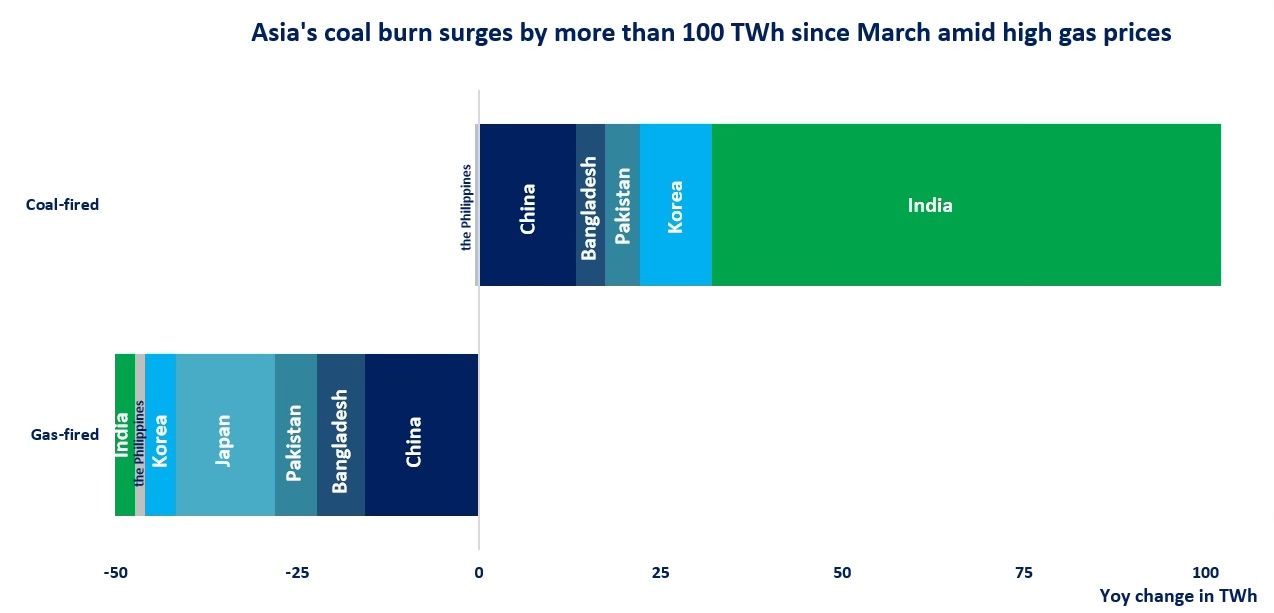
Australian High-CV 6,000 surged above 132 USD/t. Mid-CV 5,500 strengthened to nearly 97 USD/t. Unpredictable developments in the Middle East, including LNG supply concerns, and uncertainty over Indonesian export quotas are providing support to Australian coal. According to market sources, power utilities in Japan and South Korea are seeking to rebuild inventories after increasing coal consumption to conserve LNG reserves. Demand from China is supporting Australian Mid-CV prices.
Australia’s HCC metallurgical coal index continued to advance, reaching 248 USD/t. Metallurgical coal quotations soared, driven by strong demand from China on the back of continued price gains for premium material in the domestic market.
Because of the strict safety inspections, most suspended mines in Shanxi province have yet to resume operations, leading to supply shortages and declining port inventories. Buyers have intensified restocking, contributing to price gains across many coking coal grades.
Source: CCA