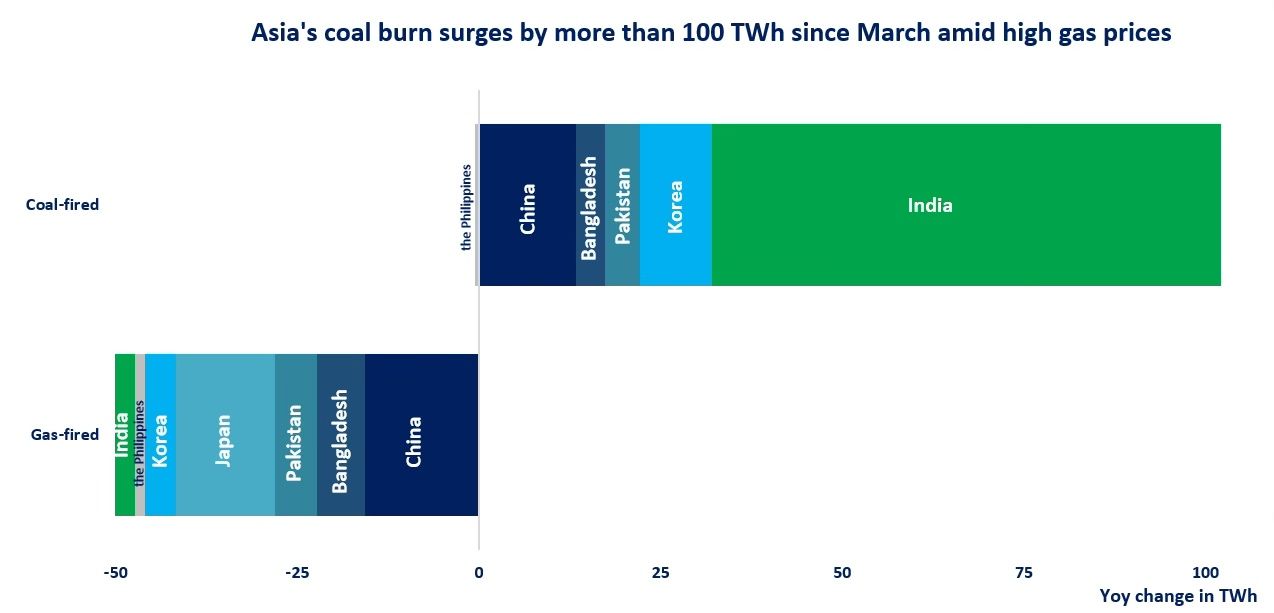
Global coal prices strengthened over the past week as tighter supply, rising winter demand and continued energy market risks supported major thermal coal markets.
Overall strengthening was observed in the coal market over the past week. Indices in Europe rose; South African and Colombian coal became more expensive; prices in China increased; in Australia, thermal and metallurgical coal quotations moved in different directions.
European thermal coal quotations continued their upward movement over the past week, exceeding 149 USD/t. Indices hit a 3-year high amid rising gas, oil, and electricity prices due to the ongoing blockade of the Strait of Hormuz and restricted supplies of Kazakh coal to European countries. Furthermore, thermal coal shipments from Colombia dropped 31%, from 1.2 mio t to 0.8 mio t.
Gas quotations on the TTF hub broke through the psychological 1,000 USD mark as of October 14, 2026, surging nearly 10% to 1,011.93 USD/1,000 m3 (+89.46 USD/1,000 m3 w-o-w), as countries in the region seek to actively replenish inventories. Total EU underground gas storage stood at 73.9% (+1.1 ppts w-o-w), 9.5 ppts below last year’s level of 83.4%.
South African High-CV 6,000 strengthened above 128 USD/t, following the European market, also aided by disruptions to the South African rail network and geopolitical tensions in the Middle East. Meanwhile, steady demand and rising global prices remain the key market drivers.
Rail operator Transnet halted both North Corridor lines from October 10–11, caused by a power outage that disrupted coal deliveries to the Richards Bay terminal. The power supply failure resulted in a cumulative loss of 174k t of coal to the market. Against this backdrop, deals for South African coal with November loading emerged in India — buyers were seeking import cargoes because of domestic supply constraints and rising demand as the monsoon season ended.
Transnet intends to rail 61.3 mio t of coal for export in the current fiscal year, versus 58.5 mio t in the year ended March 2026, but derailments, cable theft, as well as power outages continue to hinder these plans.
In China, spot prices for 5,500 NAR coal at the port of Qinhuangdao rose to 150 USD/t, following the end of the National Day celebrations (October, 1-7, 2026), driven by the resumption of economic activity. Furthermore, the start of a 20-day scheduled maintenance period on the Daqin Railway is, in turn, restricting coal supplies to ports in the Bohai Gulf.
Colder weather in northern China and forecasted further temperature declines across most northern regions from October 15 have spurred thermal coal demand: temperatures are expected to drop below 20°C in northern China and below 10°C in the northeast after falling 6–12°C in several regions on October 12.
Deteriorating weather has prompted many power plants and heating companies to accelerate stockpiling in northeastern China, where the heating season has already begun in some areas and starts in the rest in two to three weeks; northern China has also accelerated purchases, as heating there begins in mid-November.
Unlike rising demand, no notable improvement in domestic production is evident: most mines in Shanxi are holding output well below capacity due to safety inspections, though the number of closed mines fell to 39 from 49 at the end of September. At the same time, safety pressure appears to have intensified in Inner Mongolia and Shaanxi: Ordos, the largest coal-mining region in Inner Mongolia, recently issued a new document on combating overproduction, and Shaanxi’s safety commission held a meeting on Saturday on closing hidden working faces.
Coal stocks at 9 major ports edged down to 23.78 mio t (-0.12 mio t w-o-w), while inventories at 6 major coastal thermal power plants stood at 14.47 mio t (+0.10 mio t w-o-w).
Indonesian 5,900 GAR exceeded 119 USD/t, while the price of 4,200 GAR rose to 78 USD/t. Indonesian coal spot quotations remain in an upward trend, resulting from restricted exports and production. Chinese traders actively sent inquiries in anticipation of restocking ahead of winter. In India, demand remained high as buyers seek to rebuild inventories.
Significant river shallowing, forest fires, and aggressive land clearing for palm oil in Kalimantan and Sumatra are slowing coal mining, potentially jeopardizing export volumes through year-end: Central Kalimantan has become the epicenter of the crisis, where an El Nino-driven dry season has led to forest burning, with smoke and limited visibility causing sudden production halts.
Similar critical conditions are spreading to South and West Kalimantan, as well as Sumatra’s main producing provinces: one producer in South Kalimantan noted that production capacity was unstable over the past week, given low visibility forcing pauses, and expects capacity to decline by roughly 10%.
The shallowing of key river arteries in Kalimantan and Sumatra has virtually paralyzed barge-based coal transport networks, while falling river depths in Central Kalimantan have halted shipments from that region. Indonesia’s Meteorology, Climatology and Geophysics Agency forecasts that the El Nino-driven drought will persist through year-end.
Australian High-CV 6,000 was holding at the level of 150 USD/t, while Mid-CV 5,500 climbed above 111 USD/t, strengthening by more than 3 USD/t. Steady demand and limited supply from Indonesia continue to provide support.
Australia’s HCC metallurgical coal index went down below 269 USD/t. Chinese interest was limited: price gains are being seen in the domestic and port markets and in Dalian Exchange quotations (Chinese steelmakers have recently been purchasing predominantly domestic Chinese or Mongolian coking coal), while sellers are in no hurry to offer, awaiting a demand revival from the slow recovery of domestic production in China.
Conversely, PCI coal prices climbed above 190 USD/t. Amid escalating tensions in the Black Sea due to Ukrainian drone attacks, PCI supplies from Russia’s southern ports have ceased: buyers of Russian PCI are forced to seek alternative sources, including Australia, where one supplier notes it has received seven purchase inquiries from India and Southeast Asia in recent days, not counting buyers from other regions.
Source: CCA