Global coal prices remained firm over the past week as supply constraints, winter demand and energy market risks continued to support major thermal coal markets.
The coal market continued to rise over the past week. Indices in Europe held their ground; prices in China firmed; in Australia, thermal coal became more expensive, while metallurgical coal quotations moved in different directions.
European thermal coal quotations continued to trade in the 148-150 USD/t range over the past week, reaching their highest level since early 2023, driven by firmer gas, oil, and electricity prices, resulting from the ongoing blockade of the Strait of Hormuz and restricted supplies of Kazakh coal to EU countries.
In Germany, electricity prices rose amid a 20% decline in wind generation (to 17.14 GW), while gas-fired generation increased 35% (to 7.25 GW), coal-fired generation climbed 15% (to 3.2 GW), and lignite-fired generation surged 30% (to 10.5 GW). October temperatures exceeded the historical norm by roughly 2°C, though on October 29 temperatures are expected to be 3.9°C below seasonal norms.
Gas quotations on the TTF hub held above the psychological 1,000 USD mark last week, rising to 1,048.08 USD/1,000 m3 (+55.25 USD/1,000 m3 w-o-w), as countries in the region seek to actively replenish inventories. Total EU underground gas storage stood at 74.6% (+0.7 ppts w-o-w), 8.4 ppts below last year’s level of 83.0%.
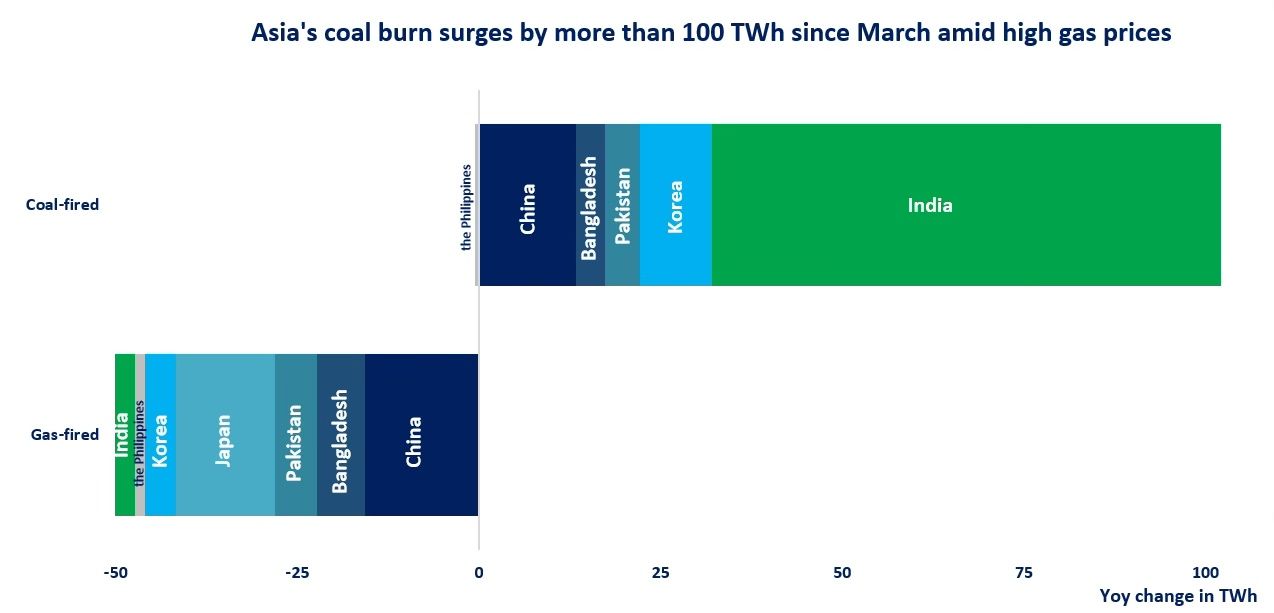
South African High-CV 6,000 jumped above 132 USD/t owing to strengthening European indices and sustained interest from India, where monsoon-related disruptions to mining and logistics have reduced domestic supplies. Indian cement producers, facing a sharp rise in petcoke prices, are considering coal purchases.
Rail operator Transnet notified customers of supply disruptions on the Ermelo-Ogies section due to a power supply system failure, with restoration timelines not yet specified. The incident followed a brief force majeure on October 10–11 that disrupted coal shipments to the RBCT terminal.
According to Transnet, trains between Ermelo and Ogies continue to run but with restrictions — slot and crew schedule disruptions are being observed; congestion is expected to persist until substation operations are fully restored. Some traders believe the incident will give sellers additional room for negotiation.
In China, spot prices for 5,500 NAR coal at the port of Qinhuangdao rose to 154 USD/t despite periodic corrections. Prices were supported by increased consumption and purchasing. Most market participants remain optimistic and generally believe a significant production increase is unlikely before mid-November, given the authorities’ approach to safety oversight.
In early October, China’s leading economic planning bodies developed an emergency coal supply mechanism designed to temporarily ease production restrictions and free up additional capacity during periods of acute shortage. The shortage is expected to be assessed based on domestic production and inventories rather than primarily on spot prices at northern ports.
Authorities may temporarily relax the restriction preventing production of more than 10% above approved annual capacity and allocate additional quotas to companies able to respond quickly to disruptions — potentially up to 1 mio t/day of additional capacity (around 400 mio t/year annualized).
Meanwhile, according to another source’s estimate, the mechanism could free up about 200 mio t/year of capacity but deliver only around 25 mio t of actual additional supply.
Unresolved safety and regulatory issues are still holding back the initiative: the proposal remains under development.
Pressure on the market could come from a Chinese authorities’ directive dated October 16 to Shanxi province to accelerate the resumption of suspended mines and ramp output back to normal, as well as to free up capacity faster. Market participants interpreted this as a response to rising domestic thermal coal prices and an effort to secure supplies ahead of the heating season.
Coal stocks at 9 major ports rose to 25.38 mio t (+1.60 mio t w-o-w), while inventories at 6 major coastal thermal power plants stood at 14.58 mio t (+0.11 mio t w-o-w).
Indonesian 5,900 GAR exceeded 120 USD/t, while the price of 4,200 GAR rose to 79 USD/t. Limited supply from Indonesia continued to shape seller sentiment and keep prices in a narrow range. Indonesian mining companies are facing disruptions from dry weather in key regions.
Indonesian producers and Asian buyers are refraining from signing long-term contracts for 2027 because of uncertainty over government-approved production quotas (RKAB) and changes to export rules — from January 01, 2027, Indonesia is transitioning to a new export model with an enhanced role for PT Danantara Sumberdaya Indonesia (DSI).
A number of companies are including protective clauses in contracts that make supplies contingent on approved RKAB quotas and domestic market obligations (DMO). The RKAB-2027 application period runs from October 1 to November 15, so final volumes may not yet be known to miners.
Australian High-CV 6,000 climbed above 153 USD/t, while Mid-CV-5,500 exceeded 114 USD/t. Market participants expect further gains. Rainy weather in Queensland has created long vessel queues at key export terminals: waiting times are around 15 days at the Dalrymple Bay terminal and 20 days at the Port of Gladstone.
Australia’s HCC metallurgical coal index dropped below 266 USD/t. Prices came under pressure from the Chinese authorities’ directive to Shanxi, as it aims to improve coking coal availability. This is the second joint statement by the agencies that has prompted some Chinese buyers to hold off on purchases and partly offset the optimism that arose after the recent rise in coking coal prices and discussions of coke price increases.
However, a number of market participants believe the downside potential is limited due to low inventories and proposed coke price increases.
Demand for coking coal from Indian consumers remained subdued, as they prefer US coal and their interest was focused on PCI.
A forward price for Low Vol PCI for Q4 2026 was fixed between Foxleigh (Queensland) and Japan’s Nippon Steel at 196.50 USD/t FOB, 15.00 USD/t above the Q3 level (181.50 USD/t FOB).
Source: CCA