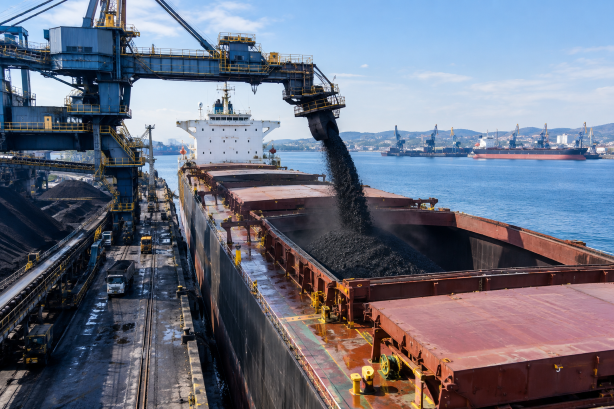
Global coal prices rose over the past week as stronger sentiment returned to key coal markets.
Upward movements prevailed in the coal market over the past week: indices in Europe rose; prices in China firmed; in Australia, thermal coal quotations showed mixed dynamics, while metallurgical prices jumped sharply.
European thermal coal indices surged above 124 USD/t. Coal found support from firmer oil and gas quotations at the TTF hub amid renewed geopolitical tensions between the US and Iran, which again raised doubts about an imminent reopening of the Strait of Hormuz. Iran declared the waterway would remain blocked until the US accepts its terms and pays reparations for damages, while the US made similar demands of Iran, weakening hopes for an agreement. Additionally, renewable and nuclear generation in Europe declined due to the heatwave.
Gas quotations on the TTF hub rose over the week to 721.67 USD/1,000 m3 (+25.93 USD/1,000 m3 w-o-w). EU underground gas storage stood at 59% (+1 ppts w-o-w), 13 ppts below last year’s level of 72%.
South African High-CV 6,000 exceeded 109 USD/t, following the European market. High-CV thermal coal prices reached a one-month high, resulting from Middle East risks and interest from Indian traders. A slight increase in sponge iron prices raised expectations of demand for South African coal from this sector, though steady availability of domestic coal in India limited interest in imported material.
Furthermore, a train derailment on August 12 severely disrupted rail deliveries to the Richards Bay Coal Terminal (RBCT). The incident occurred just a week after operator Transnet resumed operations, following scheduled annual maintenance.
Nevertheless, the steady recovery of Transnet’s rail network capacity in South Africa enables Glencore to revise its production plans and resume previously postponed projects. As Glencore’s South African coal business head Murray Houston noted, every additional 5 mio t of rail capacity requires an increase in export volumes of more than 1 mio t, meaning not just optimizing current volumes but fully integrating new export tonnage into the system.
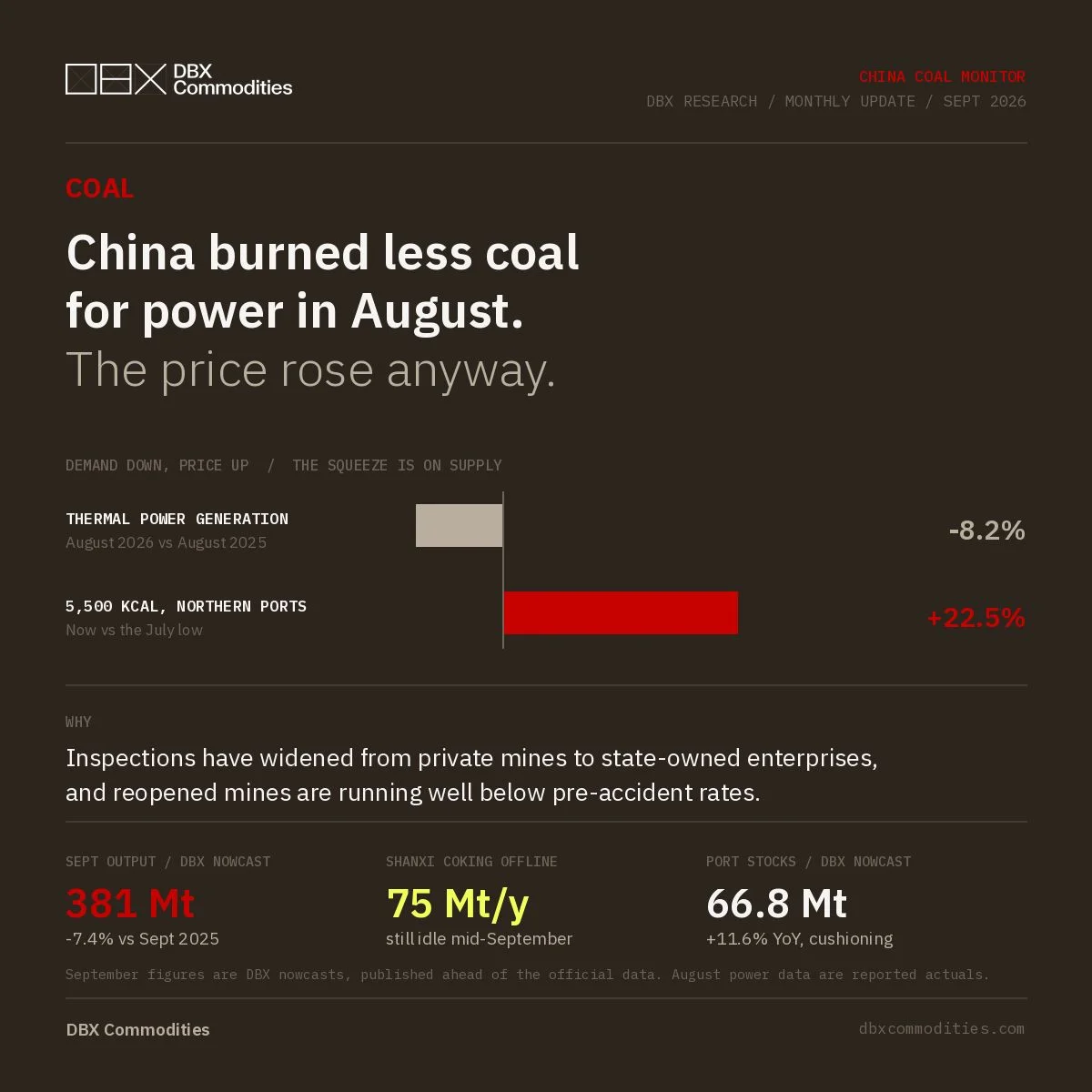
In China, spot prices for 5,500 NAR coal at the port of Qinhuangdao strengthened above 126 USD/t. The Chinese thermal coal market remains in an upward trend on the back of continued inventory drawdowns and supply constraints. Output is being curbed by stepped-up safety inspections: authorities in ten provinces, including Inner Mongolia, Shanxi, and Shaanxi, have tightened oversight of potential production underreporting, safety violations, and video falsification.
A significant production recovery is considered unlikely, suggesting continued support for quotations in the coming months. However, some market participants believe the current price rally is largely driven by speculative sentiment that could fade.
According to a policy document published August 10 by the National Development and Reform Commission (NDRC), coal remains the country’s primary energy reserve through 2030, despite an active shift toward green energy. The 15th Five-Year Plan for the coal industry anticipates a peak in coal consumption by 2030 and an increase in the share of non-fossil sources to 25%. Priorities include mine modernization, artificial intelligence adoption, improved coal quality and expanded use as feedstock.
Coal stocks at 9 major ports fell to 26.51 mio t (-0.87 mio t w-o-w), while inventories at 6 major coastal thermal power plants totaled 14.01 mio t (-0.25 mio t w-o-w).
Indonesian 5,900 GAR rose to 104.5 USD/t, while the price of 4,200 GAR climbed to nearly 64 USD/t. Coal shortages in China are spurring interest in Indonesian material, with low-CV coal particularly in demand among Chinese traders for blending purposes. Supply from Indonesia remains constrained, as many mining companies still lack clarity on the possibility of ramping up production capacity.
Australian High-CV 6,000 dropped below 128 USD/t. Mid-CV 5,500 strengthened to 95-96 USD/t. Australian coal prices showed mixed dynamics amid uncertainty over Indonesian supply and the Middle East situation, though higher freight rates are weighing on quotations.
Australia is seeing a seasonal decline in shipments: July showed a significant increase in planned maintenance at coal terminals, particularly in Queensland, as well as at the Kooragang terminal (ship-loader maintenance through November 20).
Japanese utility JERA halted three coal-fired units: on August 12, the 1 GW Unit No. 4 at Hekinan power station due to a boiler issue, and on August 11, the 600 MW Unit No. 5 at Hirono power station because of fuel constraints, while simultaneously imposing a 420 MW restriction on the 600 MW Unit No. 6 at the same station. Timelines for restoration have not yet been specified. The JERA unit outages could temporarily reduce coal demand in the country.
Australia’s HCC metallurgical coal index rebounded to 224 USD/t after declining the previous week. The price rise is driven by a shortage of premium grades and improved sentiment in the Chinese market. Buyers resumed purchases, and traders became more active amid futures gains. Some Chinese mines reported strong sales even after price increases, with many operations reporting minimal or no inventories. China also saw active demand for Australian and Russian PCI coal amid limited domestic supply.
Moreover, fuel shortages for mining operations in Mongolia are adding further uncertainty. The country has stepped up diplomatic efforts to secure supplies from neighboring countries. However, if the issue is not resolved in the coming weeks, Mongolian metallurgical coal supplies could face disruptions.
Source: CCA