Kazakh coal transit through Russia increased strongly in January–August 2026, although growing rail and port constraints began weighing on volumes toward the end of the period.
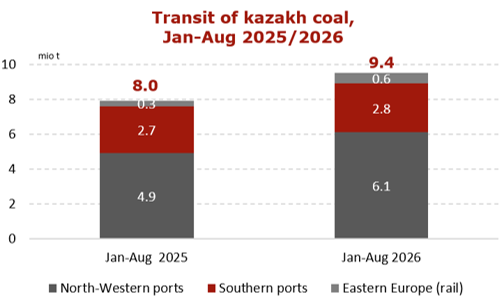
Transit of Kazakh coal through Russia in January–August 2026 jumped by 17.5% to 9.4 mio t (+1.4 mio t y-o-y). The positive dynamics were driven by a sharp rise in EU demand amid gas prices skyrocketing to almost €1,000/1,000 m³, which made coal a more cost-effective fuel for generation, and Kazakh material one of the most attractive on the European market given the sanctions against Russia.
However, since the beginning of September, according to some reports, Russian Railways (RZD) has been restricting the transportation of cargo, including Kazakh coal, prioritising agricultural products in the direction of Ust-Luga.
This is due to the suspension of transshipment in the Black Sea following attacks on Russia’s port infrastructure and vessels, which forced shippers to redirect export cargo to north-western ports. As a result, transit of Kazakh coal dropped to 1.1 mio t in August compared to 1.2 mio t in July 2026.
Thus, in the second half of the year, total coal transit volumes may decline if transshipment at southern ports does not resume, as competition for the infrastructure of north-western terminals will intensify, leaving Kazakh cargo with fewer transportation opportunities.
With the restriction of transit of Kazakh material, the situation has received a price impulse: active purchasing has begun in Poland, and some traders expect a possible suspension of seaborne shipments in winter. Buyers are forced to look for more expensive routes or alternative material, including Colombian coal, which supports prices and increases volatility on the European market..
Source: CCA