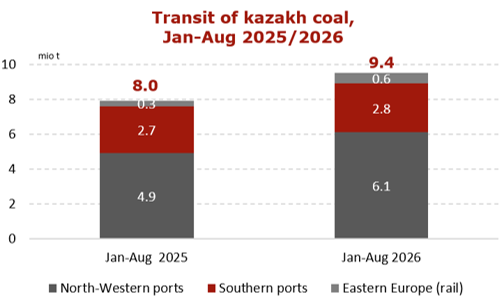



Russian coal exports to Turkey declined sharply in January-August 2026 as Black Sea shipping disruption, limited rail capacity and weak export profitability continued to pressure supplies.
In January-August 2026 Russian coal exports to Turkey dropped to 15.9 mio t (-5.4 mio t or -25.4% y-o-y).
Meanwhile, in Jan-Aug 2026, Turkey’s total coal imports, including thermal coal, coking coal and anthracite, fell to 23.9 mio t (-4.4 mio t or -15.5% y-o-y).
In Jan-Aug 2026, Colombian deliveries to Turkey totaled 2.4 mio t (-4.0% y-o-y), while Kazakhstan boosted its coal supplies to 2.1 mio t (+75.0% y-o-y). Shipments from the US surged to 2.1 mio t (+61.5%).
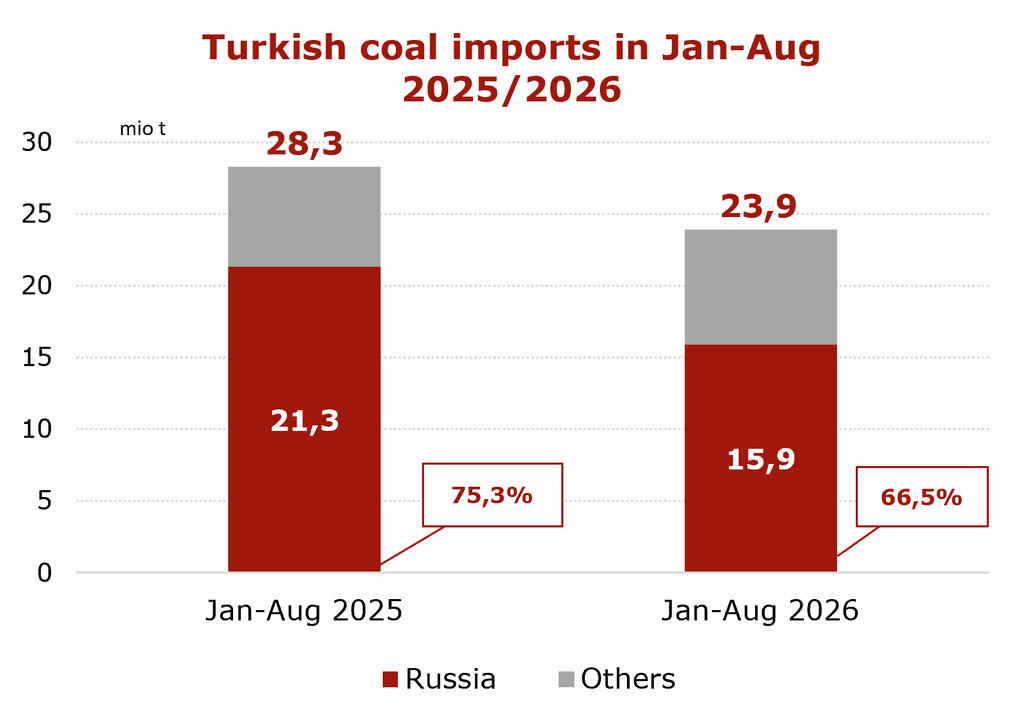
Russia’s share in Turkey’s coal imports decreased by 8.8 percentage points to 66.5% in Jan-Aug 2026 (vs. 75.3% y-o-y).
Most producers are forced to export coal at zero or negative profitability. Shipments via Southern and Northwestern ports are loss-making, while access to rail capacity remains limited amid rising rail tariffs.
Furthermore, in 2026, Russian and Kazakh coal shipments via Black Sea ports ground to a complete halt, with the key Southern transshipment hub at Taman ceasing all coal-handling operations.
The suspension follows a surge in Ukrainian drone strikes on commercial vessels in the region, which prompted a wave of insurers to withdraw coverage for voyages in the Azov–Black Sea basin. The pullback has effectively frozen traffic at the port, which had accounted for the bulk of Russian and Kazakh coal exports routed through the southern corridor.
The disruptions have already sent Turkish coal prices climbing sharply, and traders expect further upside in the near term as supply tightens and uncertainty over shipping security persists.
This situation carries the risk of reducing Russian coal exports’ share in the key remaining markets for Russian suppliers, including the Turkish market, where since 2022 Russian coal has successfully replaced Colombia as the main supplier.
Source: CCA