Global coal prices continued to climb over the past week as Middle East tensions, tighter supply and stronger Asian demand supported both thermal and metallurgical markets.
The upward trend continued in the coal market over the past week. Thermal coal prices rose in Europe and China. Australian thermal and metallurgical coal quotations jumped sharply.
Thermal coal indices in the European market reached a 3-month high above 137 USD/t amid escalation of the US-Iran conflict and threats to LNG supplies through the Strait of Hormuz.
Germany’s Federal Ministry for Economic Affairs and Energy is studying the possibility of using coal-fired power plants from the reserve to mitigate price spikes during periods of low wind. Germany maintains around 7 GW of hard coal capacity in reserve, currently used by operators to balance grid overloads.
Amid renewed US-Iran strikes, gas quotations on the TTF hub surged over the week to 857.48 USD/1,000 m3 (+35.52 USD/1,000 m3 w-o-w). President Donald Trump threatened further strikes. EU underground gas storage stood at 65.4% (+1.9 ppts w-o-w), 11.6 ppts below last year’s level of 77%.
South African High-CV 6,000 reached a 2-month high, exceeding 124 USD/t, driven by rising demand from Indian sponge iron producers and escalating Middle East conflict. India is seeing steady demand after the rainy season amid domestic supply constraints and rising sponge iron prices.
Transnet fully restored rail traffic to the Richards Bay Coal Terminal (RBCT) after the August 21 derailment of 29 coal wagons forced the closure of both lines. Both North Corridor lines are now operational, with efforts focused on stabilizing the network.
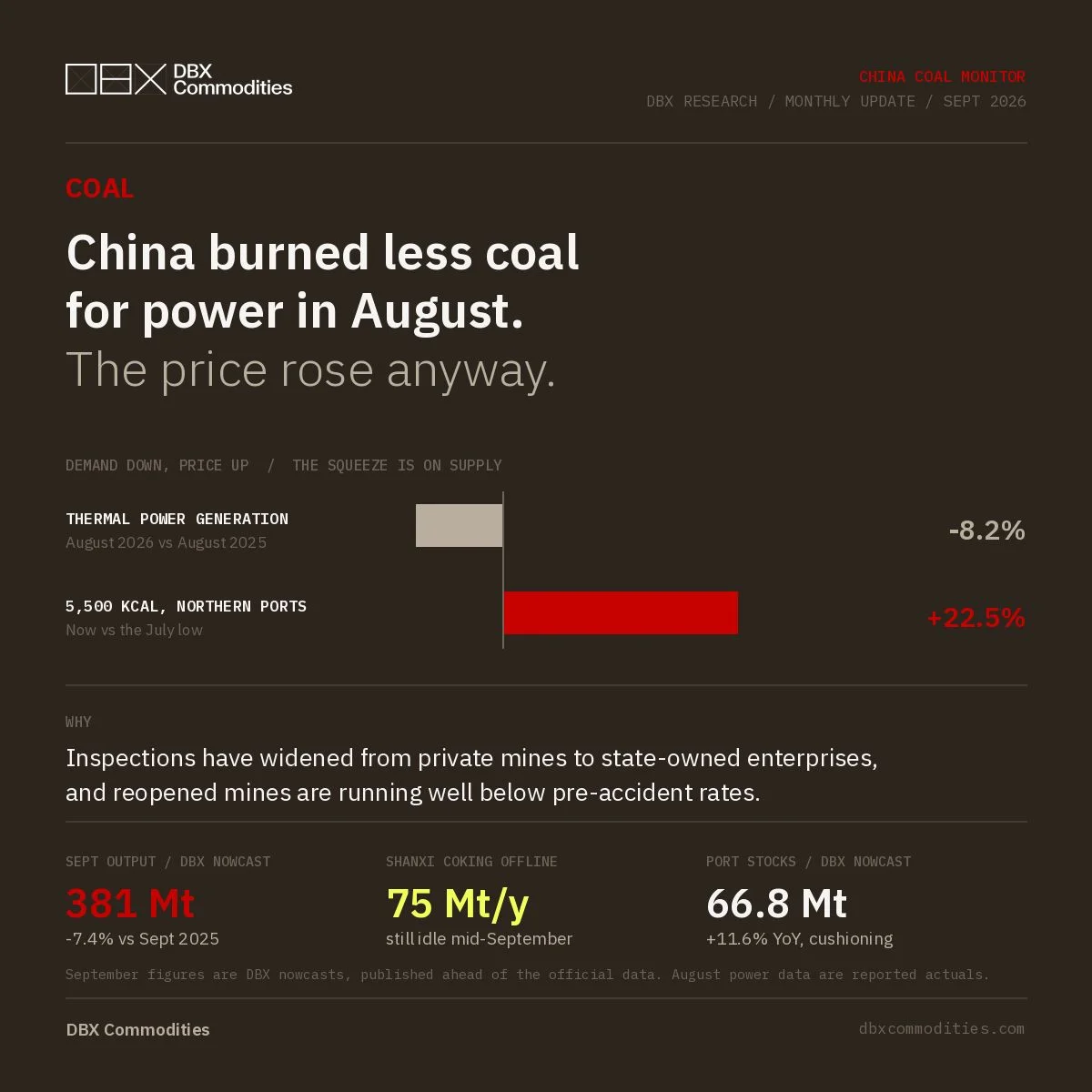
In China, spot prices for 5,500 NAR coal at the port of Qinhuangdao soared above 132 USD/t because of declining inventories and reduced spot supply. Steady restocking demand from chemical and cement producers ahead of the seasonal production ramp-up supported the upward momentum. Additionally, Chinese regulators have decided to tighten safety controls at state-owned coal mines, which may prolong supply disruptions. However, further significant price gains could trigger government intervention.
However, negotiations to allow coal mines to produce 30% above approved quotas (versus the current 10%) stalled after the National Energy Administration and the Mine Safety Administration failed to reach agreement, resulting from safety concerns and disagreements over regulatory authority. Stricter compliance marks a significant shift from past practice, when mines systematically produced 20–50% above approved volumes.
Coal stocks at 9 major ports plunged to 23.94 mio t (-2.08 mio t w-o-w), while inventories at 6 major coastal thermal power plants stood at 14.19 mio t (+0.09 mio t w-o-w).
Indonesian 5,900 GAR rose above 107 USD/t, while the price of 4,200 GAR increased to nearly 69 USD/t, following supply constraints from limited mining capacity and barge transport disruptions. Falling water levels on key Indonesian coal transport routes during the dry season, compounded by a strengthening El Nino, are hindering barge movements and reducing seaborne thermal coal supplies, while producers continue to face delays in production quota approvals.
Currently, some producers are relying on stockpiles and deferring shipments rather than declaring force majeure. For some companies in Central Kalimantan, barge operations have completely stopped. In East Kalimantan, the impact is somewhat less severe. In South Kalimantan, one major producer reported a 10–12% decline in barge efficiency. Indonesia’s Meteorology, Climatology and Geophysics Agency warned that dry conditions could persist into Q1 2027.
Australian High-CV 6,000 jumped above 144 USD/t. Strong buyer interest was noted over the past week for fixed-price high-CV cargoes for November loading.
Meanwhile, loading operations at the Newcastle Coal Infrastructure Group (NCIG) terminal in the Port of Newcastle were disrupted by intermittent strikes, with vessel waiting times averaging eight days this week.
Australia’s HCC metallurgical coal index continued to strengthen, rising to 275 USD/t. Demand from China remains high due to limited domestic supply from ongoing safety inspections and slower Mongolian coal deliveries.
PCI coal prices reached a 3.5-year high at 203-204 USD/t, driven by capacity constraints from safety inspections in China, where demand remains strong, as well as limited availability of material from Russia.
Source: CCA