Global coal prices continued to rise over the past week as supply risks, stronger LNG prices and tightening regional coal availability supported key markets.
The upward trend in the global coal market persisted throughout the week: in Europe, quotations showed positive dynamics; in China, coal became more expensive; in Australia, prices for both thermal and metallurgical material continued to strengthen.
Thermal coal quotations in the European market kept rising to 133 USD/t on the back of uncertainty over LNG supplies through the Strait of Hormuz and low gas inventories in European storage facilities. Volatility in the paper market was driven by another round of US-Iran negotiations mediated by Pakistan. Islamabad is attempting to broker a new 60-day truce to at least unblock passage through the Strait.
Gas quotations on the TTF hub surged over the week to 821.96 USD/1,000 m3 (+48.79 USD/1,000 m3 or +6.3% w-o-w). EU underground gas storage stood at 63.5% (+1.9 ppts w-o-w), 12.7 ppts below last year’s level of 76.2%.
South African High-CV 6,000 rose above 116 USD/t. Transnet partially resumed rail traffic to the Richards Bay Coal Terminal (RBCT) on August 25, after a derailment of 29 coal railcars on August 21 forced the closure of both lines.
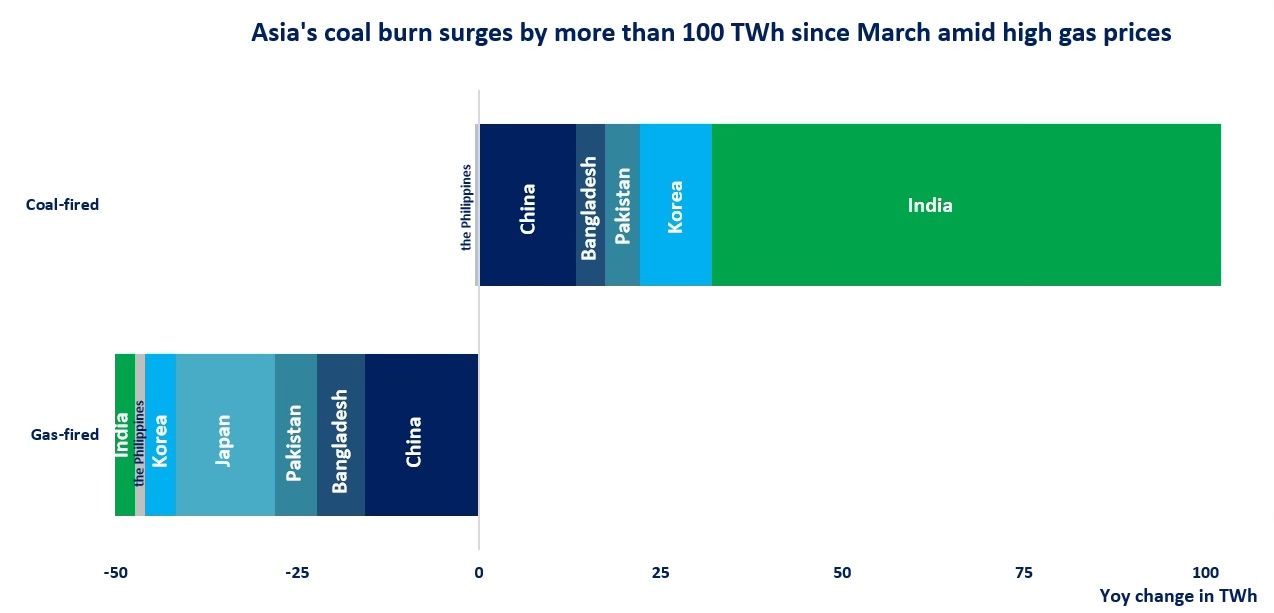
Increased coal exports from RBCT last week and reduced deliveries because of the accident led to a nearly 10% drop in terminal stocks to 3.83 mio t. Pakistan became the largest export destination for South African coal, exceeding weekly volumes to India for the second time this month. Export volumes to Pakistan for the week reached 287k t, compared with 154k t to India. Demand from Pakistan is likely to persist due to an acute gas shortage, linked to the US-Iran conflict. Other destinations for South African coal included Sri Lanka, Israel, and Yemen.
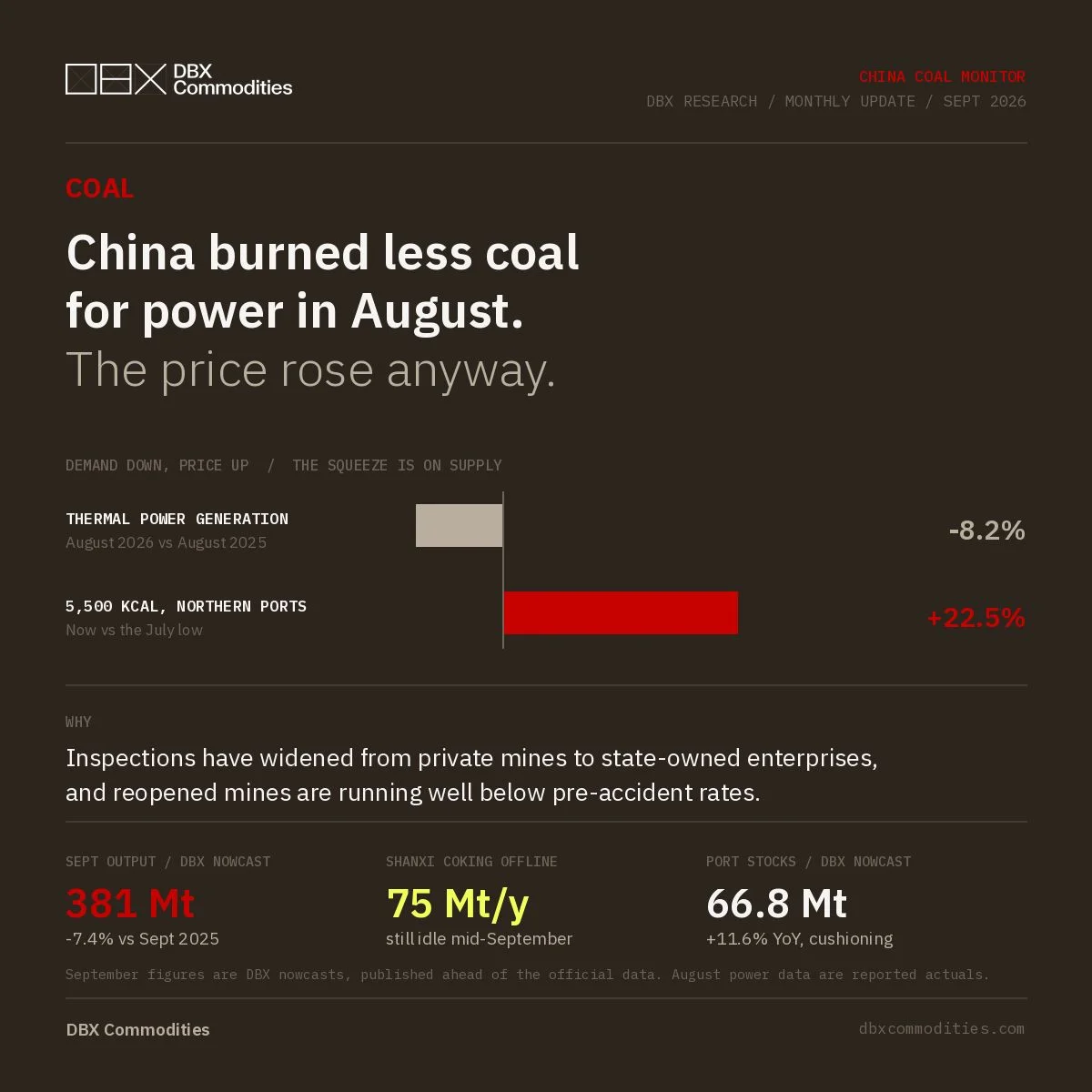
In China, spot prices for 5,500 NAR coal at the port of Qinhuangdao strengthened to 127–128 USD/t. Domestic thermal coal quotations at northern loading ports rose amid a sustained reduction in spot market supply in recent weeks. Supply tightened as many small mines suspended operations after exhausting monthly production quotas, some operations were forced to curtail output due to heavy rains, and port inventories declined as coastal consumers increased purchases ahead of an approaching series of typhoons.
Constraints persist on high-quality material output, which is most in demand from the chemical and metallurgical sectors. According to forecasts, production volumes may begin to rise from September, when a number of mines complete maintenance work.
Coal stocks at 9 major ports fell to 26.02 mio t (-0.75 mio t w-o-w), while inventories at 6 major coastal thermal power plants stood at 14.10 mio t (+0.08 mio t w-o-w).
Indonesian 5,900 GAR rose to 105.5 USD/t, while the price of 4,200 GAR climbed to 66.5 USD/t. Indonesian coal market participants are monitoring growing supply disruptions from Central Kalimantan, where falling water levels on the Barito River have forced some producers to declare force majeure. Operations in this area primarily mine mid- and high-CV coal.
Prolonged reductions in river depth due to a strong El Nino (leading to drier-than-normal conditions across much of Indonesia) may constrain coal transport from mines to export terminals, potentially reducing seaborne supplies at a time when Indonesian output is already facing constraints from delays in RKAB production quota approvals.
According to market participants, buyers of Indonesian material are willing to accept higher prices ahead of the off-season, given supply constraints in both Indonesia and China. Several deals have been reported for September loading of 4,200 GAR on Panamax vessels at 70–71 USD/t FOB Kalimantan. These transactions were concluded at prices above analytical agency quotations.
Australian High-CV 6,000 jumped above 137 USD/t. Quotations were supported by rising LNG prices and the need to conserve gas amid unpredictable developments in the Middle East. Furthermore, uncertainty over Indonesian supply, hot weather, and more active air conditioning use in several Northeast Asian countries are also supporting indices.
Australia’s HCC metallurgical coal index continued to strengthen, rising to 265 USD/t. Demand from China remains high, resulting from limited domestic supply caused by ongoing safety inspections in Shanxi province, as well as slower Mongolian coal shipments. Market participants expect a potential recovery in Mongolian exports amid reports that local authorities are seeking to increase diesel imports from China, the shortage of which has been affecting coal production.
Russian PCI prices rose, following strong demand from China amid domestic supply shortages and limited availability of material from Russia. CFR prices are increasing due to higher freight costs: Indian and Indonesian buyers are seeking alternative supplies from Baltic and Far Eastern ports, as shipments from Russia’s southern ports have been halted.
Source: CCA