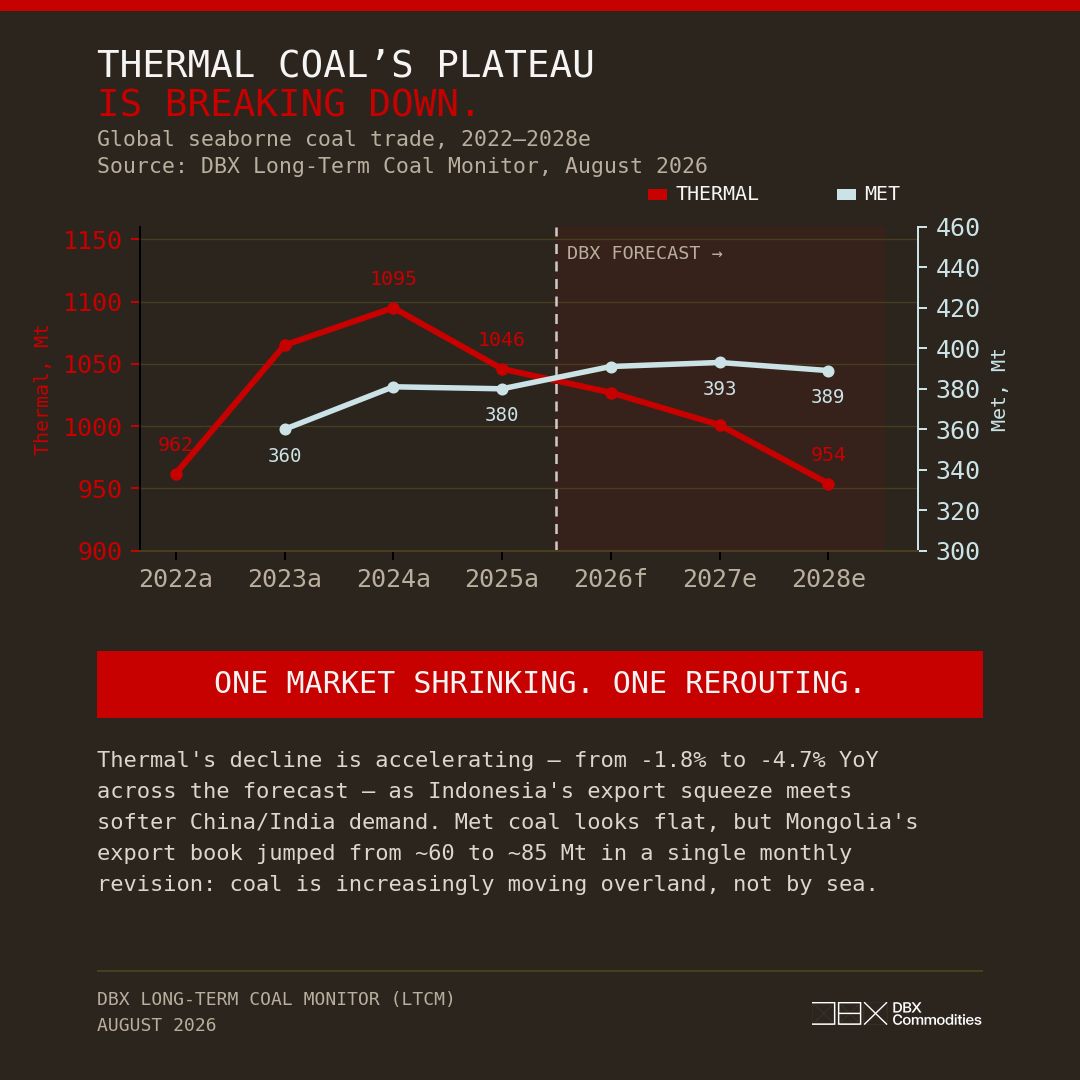
Global coal prices moved mostly lower over the past week as European coal weakened, while China strengthened and Australian markets showed mixed dynamics.
Downward dynamics prevailed in the coal market over the past week. Indices in Europe declined; prices in China strengthened; in Australia, thermal coal quotations moved in different directions, premium metallurgical coal fell, while PCI coal corrected upwards.
European coal quotations declined below 135 USD/t over the past week, following gas prices. Gas and oil contracts fell sharply early in the trading session amid hopes for renewed US-Iran dialogue and a possible reopening of the Strait of Hormuz.
Germany has committed to a complete phase-out of coal, oil, and gas by 2045, according to a roadmap presented Wednesday to the UN General Assembly. The phase-out of coal-fired generation is already enshrined in law. All coal-fired power plants must cease operations no later than 2038, with capacities gradually reduced in the interim. A shift of the deadline to 2035 is also under consideration.
Margins at German coal-fired power plants increased over the past week due to higher electricity prices and reduced renewable generation. Coal spreads jumped to 61.48 EUR/MWh from 49.00 EUR/MWh. Electricity prices rose from nearly 177.00 EUR/MWh to 190.00 EUR/MWh.
Amid falling gas prices, gas-fired plants returned to profitability at 5.86 EUR/MWh, compared with a loss of 17.38 EUR/MWh a week earlier. The renewable share of the power mix fell to just under 60% from 67%, while the fossil fuel share rose by just over 7% over the same period.
Gas quotations on the TTF hub fell 5% over the week to 881.22 USD/1,000 m3 (-47.55 USD/1,000 m3 w-o-w). EU underground gas storage stood at 70.1% (+1.4 ppts w-o-w), 11.3 ppts below last year’s level of 81.4%.
South African High-CV 6,000 corrected from three-year highs to 121 USD/t, ending a three-week rally as market activity in India slowed due to holidays. Sponge iron producers withdrew from the import market, and a fairly notable weakening of offers was observed across all participants. Nearly all sellers are offering standard South African coals at a marked discount to the API4 index.
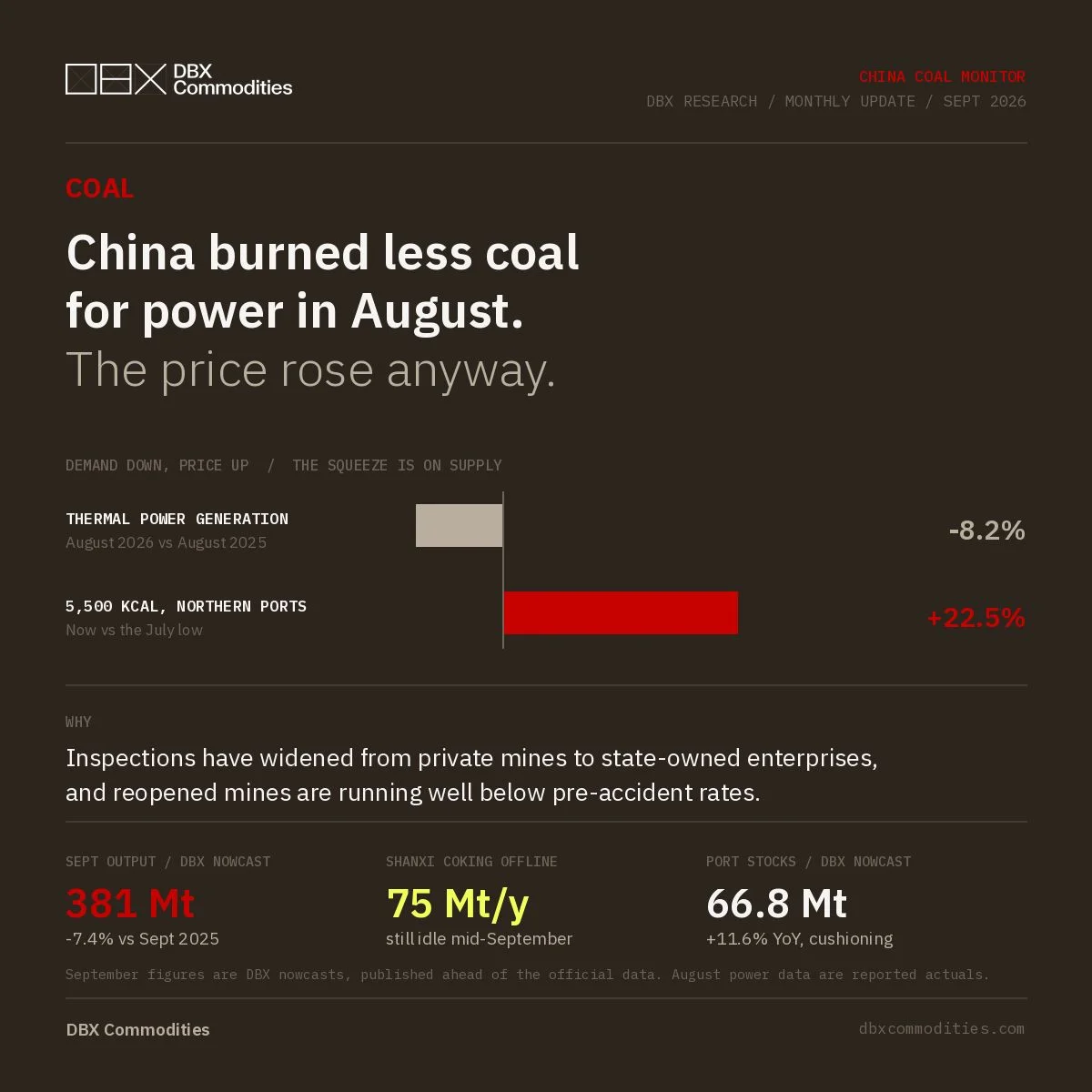
In China, spot prices for 5,500 NAR coal at the port of Qinhuangdao rose to 146 USD/t amid supply uncertainty, which remained steady but constrained in major mining regions. Large mines continued operating normally, but overall output was curbed by capacity restrictions and strict safety inspections ahead of the autumn holidays (National Day, October 1–7).
Additionally, hot weather returned intermittently in some regions, and hydropower output weakened, contributing to higher coal consumption.
Some mines have scheduled maintenance for the coming days, and many small operations are expected to slow production after exhausting monthly quotas. This suggests significant price volatility is unlikely in the near term, as supply will generally remain constrained.
Quotations were also supported by restocking ahead of scheduled maintenance on the Daqin-Qinhuangdao rail line, which begins in early October and will last about 25 days.
Coal stocks at 9 major ports stood at 24.53 mio t (+0.70 mio t w-o-w), while inventories at 6 major coastal thermal power plants were 14.33 mio t (+0.11 mio t w-o-w).
The Indonesian 5,900 GAR remained at 114 USD/t, while the price of 4,200 GAR declined to 75.5 USD/t.
Indonesian coal spot quotations showed mixed dynamics. Spot volumes remain limited due to sustained domestic demand and low water levels in Kalimantan, providing support to prices. Although several key producers received approval to increase output in the remaining months of the year, no influx of spot cargo offers materialized.
However, some market participants expect the situation to improve soon as the rainy season approaches and are holding off on purchases while monitoring further developments.
Meanwhile, Indonesia, the largest coal exporter, has more than doubled its coal imports since the start of the year due to reduced production. According to preliminary data, in the first 8.5 months of 2026, the country imported 10.13 mio t of thermal coal (+5.64 mio t or +125% y-o-y). This volume already exceeds last year’s figure (8.59 mio t).
Australian High-CV 6,000 held at 144 USD/t amid growing interest in index-linked deals, while mid-CV material became cheaper.
The New South Wales Independent Planning Commission (IPC) has postponed until September 30 its decision on approving the Hunter Valley Operations extension project, which would extend the life of two thermal coal export mines. Glencore and Yancoal Australia expressed concern and disappointment over the delay in a joint statement.
Australia’s HCC metallurgical coal index fell to 275 USD/t, as weak buying interest from Chinese and Indian markets kept the short-term outlook bearish.
Meanwhile, PCI coal prices rebounded after a downward correction, as traders had been aggressively cutting offer prices due to improved Russian material supply in order to sell their cargoes to end-users and close positions before the Chinese holidays, but that bearish sentiment has now eased.
Source: CCA