The Russian coal industry is set for a major long-term transformation under a new government program outlining production, export and regional development through 2050.
The Russian government has approved a program for the development of the country’s coal industry through 2050. The document outlines four scenarios: stress, conservative, inertial and target, depending on global demand and price dynamics, sanctions restrictions and operating conditions for the industry.
Under the target scenario, coal output rises from 443.0 mio t in 2024 to 530.1 mio t in 2030, 595.2 mio t in 2036 and 662.0 mio t by 2050. That implies production growth of roughly 49% by the end of the forecast period.
The inertial scenario envisages output of 491.6 mio t in 2030, 545.3 mio t in 2036 and 586.4 mio t in 2050. Under the conservative scenario, production would total 454.0 mio t, 460.5 mio t and 460.8 mio t respectively, while the stress scenario projects a decline to 438.3 mio t, 381.3 miol t and 318.9 mio t.
Exports under the target scenario increase from 197.6 mio t in 2024 to 266.7 mio t in 2030, 320.2 mio t in 2036 and 350.1 mio t in 2050. Under the conservative scenario, exports reach 238.2 mio t by 2050, under the inertial scenario 294.8 mio t, while the stress scenario projects a decline to 100.5 mio t.
Domestic market deliveries under the target scenario rise from 179.0 mio t in 2024 to 199.2 mio tin 2030, 202.8 mio t in 2036 and 231.7 mio t in 2050. Coal imports are seen at 13 mio t in 2030 and 12 mio t each in 2036 and 2050.
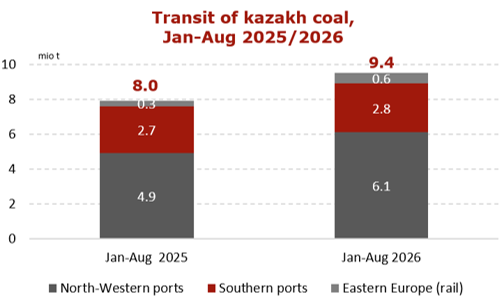
The authorities plan to support domestic demand through coal-fired generation, the modernization and construction of power plants, and increased use of thermal coal in industry, including by reducing coal imports from Kazakhstan and replacing them with Russian material.
Higher output and exports imply a further increase in shipments towards Asian markets. Under the target scenario, export coal shipments via the Russian Railways network to the east rise from 111.4 mio t in 2024 to 139.7 mio t in 2030, 204.3 mio t in 2036 and 220.8 mio t in 2050. Under the conservative scenario, shipments total 119.4 mio t in 2030, 124.8 mio t in 2036 and 122.2 mio t in 2050.
One of the key structural shifts envisaged by the program is a further relocation of coal production to Eastern Siberia and the Far East. The share of these regions in total Russian output is to increase from 48.3% in 2024 to 51–56% in 2036 and 54–57% in 2050.
The share of Kuzbass will gradually decline, from 44.8% in 2024 to 37.9–40.5% in 2036 and 35.1–39.2% in 2050.
As a result, growth in Russian output will increasingly be driven by coal deposits in Eastern Siberia and the Far East, which are located closer to the main export markets of the Asia-Pacific region and to Far Eastern ports. The program itself describes this process as a large-scale shift of coal production to the east of the country.
Nevertheless, eastern deposits cannot fully replace Kuzbass in terms of the quality mix of production. Kuzbass holds substantial reserves of high-quality thermal and coking coal of premium grades, and the resource base with comparable characteristics in other Russian coal regions is limited.
Therefore, despite the gradual decline in Kuzbass share of total Russian output and the shift of production growth to the east, the region will retain strategic importance as a key source of high-quality coal products for both domestic and export markets.
Source: CCA