

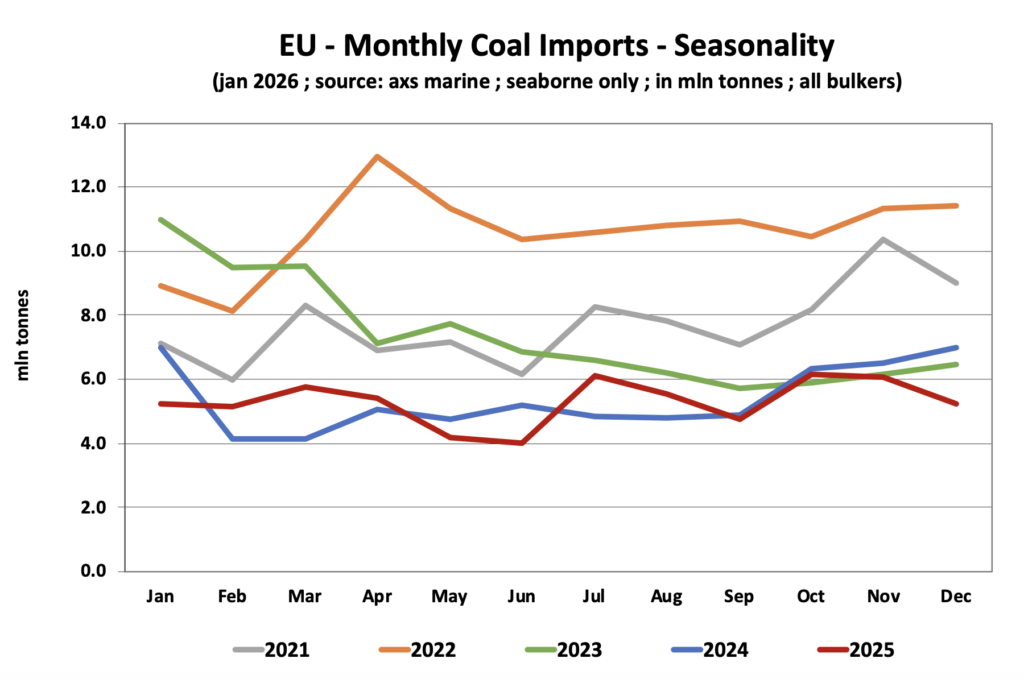
European coal imports continued to stabilise in 2025, remaining around 64 million tonnes, roughly 50% below 2022 peak levels, as the post-energy-crisis correction runs its course.
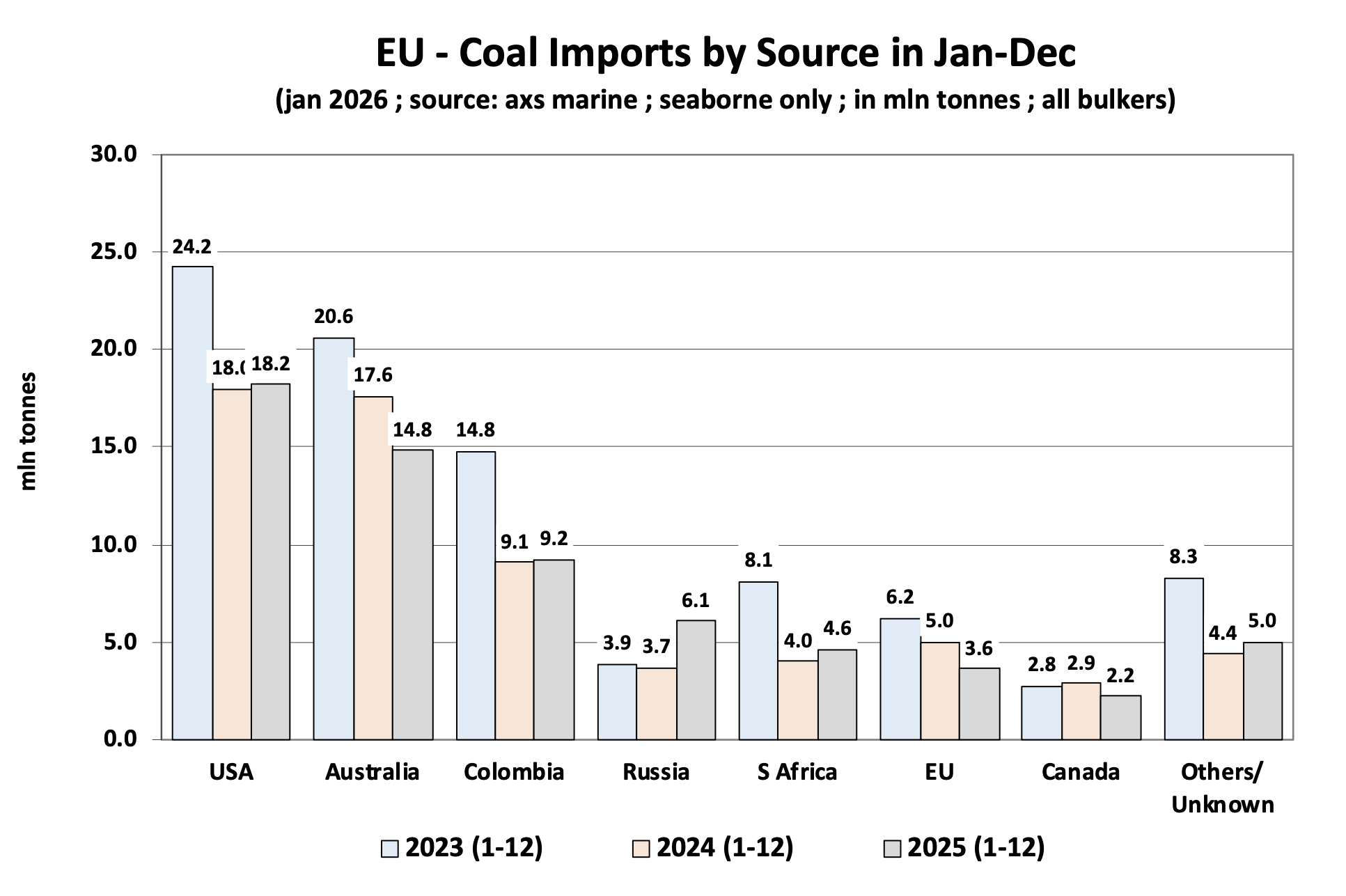
The EU’s supplier mix has also shifted structurally, with US, Australian and Colombian coal replacing Russian volumes.
European Union seaborne coal imports declined marginally by 1.4% year-on-year to 63.7 million tonnes in January–December 2025, confirming a period of stabilisation after the sharp correction seen in 2023 and 2024.
Imports are now around half the 127.6 million tonnes recorded in 2022, when coal demand surged in response to reduced Russian gas supplies.
The EU remains the fifth-largest seaborne coal importer globally, but its share of global coal trade has fallen to 4.7% in 2024, down from 9.9% in 2022, highlighting the structural decline in European coal demand.
Supply patterns have changed materially. In 2021, 44% of EU coal imports originated from Russia, but this share fell to 9.5% in 2025, including Kazakh coal shipped via Russian ports.
The United States became the largest supplier, accounting for 28.5% of EU imports (18.2 million tonnes), followed by Australia (14.8 million tonnes) and Colombia (9.2 million tonnes).
Source: Bancosta Research