

Russian coal exports are undergoing a structural shift as Yakutia and Sakhalin play a growing role in overall supply.
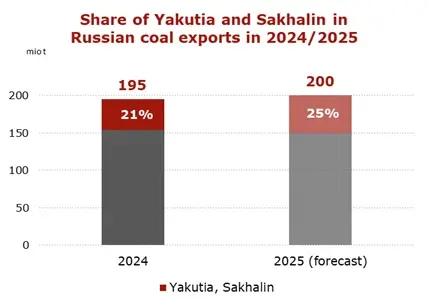
The total share of coal supplies from Yakutia and Sakhalin in Russian exports continues to steadily increase. In 2025, coal exports from Russia are forecasted to grow to 200 milo t (+5 mio t or +2.6% vs. 2024). Meanwhile, the share of coal from Yakutia and Sakhalin in Russian exports will rise from 21% in 2024 to 25% in 2025, or from 41.2 mio t to 50 mio t (+8.8 mio t or +21.4%).
The logistics chains of Elga (Yakutia) and Sakhalin, which is an isolated mining region, are linked to their own seaports and do not depend on the capacity of the BAM and Trans-Siberian Railway, or on the tariff policy and plans of Russian Railways (RZD). Their share is growing on the back of declining production in coal-mining regions.
In January-October 2025, output in Kuzbass dropped to 41.4 mio t (-6.4 mio t or -3.9% y-o-y). On the contrary, coal production in Sakhalin climbed to 15 mio t (+1.2 mio t or +9%), and in Yakutia totalled 41.4 mio t (+0.73 mio t or +1.8%), including Elgaugol’s volumes, which surged to 28.8 mio t (+5.6 mio t or +24.1%).
Sakhalin and Yakutia competitive advantage is determined by its significantly lower logistical leverage. The distance from Kuzbass to the ports of the Far East is 6,500 km, from Elga to its own terminal in Chumikan is about 600 km along a dedicated branch line, and from the Yakutia deposits to the Far Eastern ports is 1,500-2,000 km.
Sakhalin has the shortest distance to the ports of China. The autonomous infrastructure of Sakhalin and Elga ensures minimal tariff costs and excludes dependence on the throughput capacity of the Eastern Range.
The current situation is driving a structural transformation in Russian coal exports: high-quality coal from Kuzbass is being replaced by low-quality production from Sakhalin and Yakutia, with low consumer specifications offset by significantly cheaper logistics.
This trend limits the supply of high-quality material on the global market, leads to a reduction in Russia’s market share in premium segments, and may encourage end-users reliant on stable quality to diversify their supplies in favour of alternative exporters.
Source: CCA Analysis