

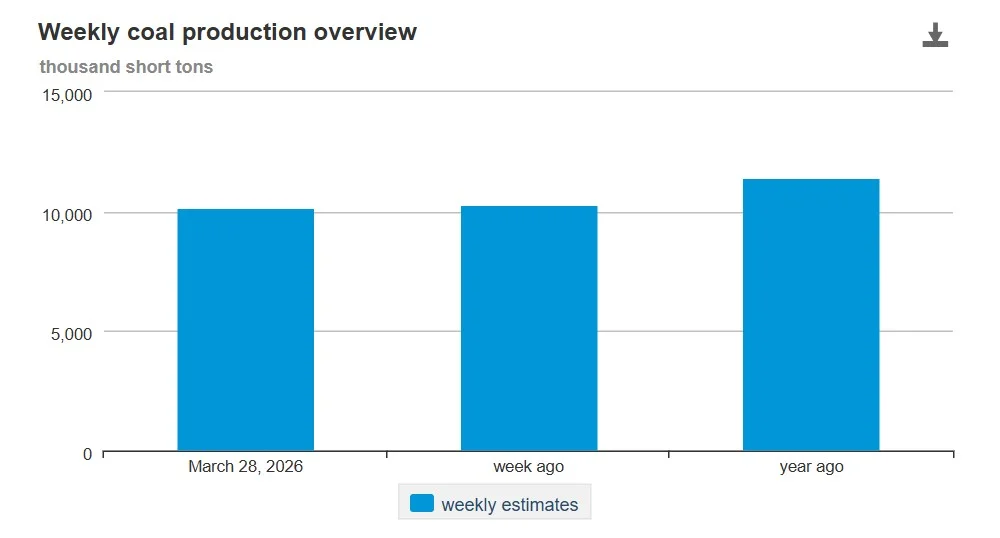
U.S. coal production remained above last year’s pace on a cumulative basis, even as weekly output softened in the latest EIA release. For the reporting week, total U.S. coal production came in at 10.168 million short tons, down from 10.289 million the previous week and below the 11.429 million recorded in the comparable week a year earlier. Year to date, however, U.S. coal production reached 128.998 million short tons, slightly ahead of the 127.993 million short tons reported for the same period last year. The 52-week total stood at 532.557 million short tons, up 3.8% from 513.104 million a year earlier.
Regionally, the Western coalfields continued to anchor national output. Western production totaled 5.469 million short tons for the week, more than half of total U.S. production, while the Appalachian region produced 3.092 million short tons and the Interior region added 1.607 million short tons.
On a year-to-date basis, the West remained the growth engine at 69.510 million short tons, up 3.2% from a year earlier, while Appalachian production rose 2.1% to 39.260 million short tons. The Interior region lagged, with year-to-date output down 8.8% to 20.227 million short tons.
At the state level, Wyoming remained the dominant producer by a wide margin, generating 3.998 million short tons during the week and 51.070 million short tons year to date. West Virginia followed at 1.594 million short tons for the week, while Pennsylvania produced 840 thousand short tons and Illinois added 682 thousand short tons.
Among notable gainers, Utah continued to post strong momentum, with year-to-date production up 24.9%, while Pennsylvania was up 9.8% and Alabama gained 10.8%. By contrast, Illinois, Indiana, Colorado, and North Dakota all showed year-to-date declines compared with the same period in 2025.
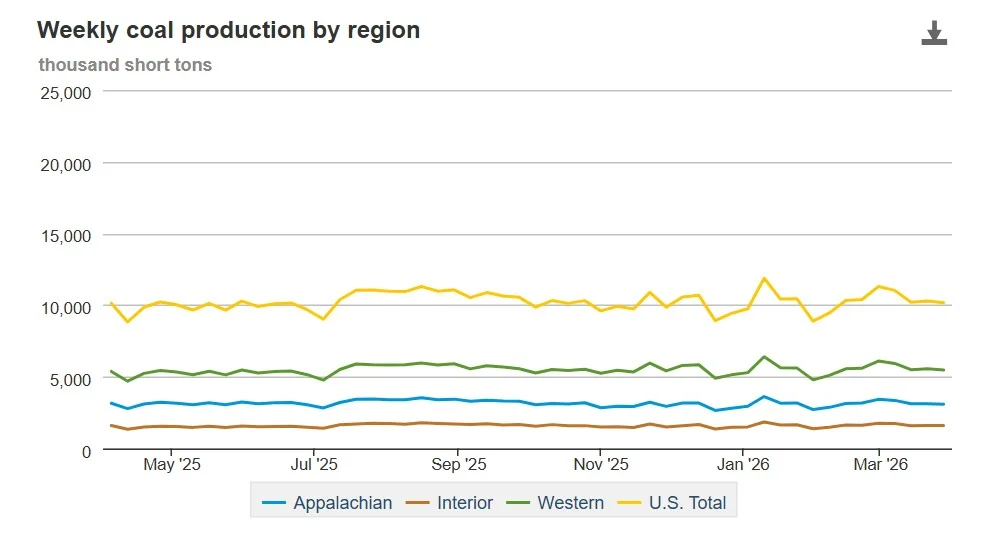 The latest weekly report should be read as a high-frequency snapshot rather than a final monthly total. EIA notes that coal production estimates are prorated to a daily basis, while railroad carload figures are not exact for the same time periods.
The agency also states that monthly coal production estimates are typically released during the first full week of the following month, making the weekly series most useful for tracking short-term production direction and regional shifts in supply.