

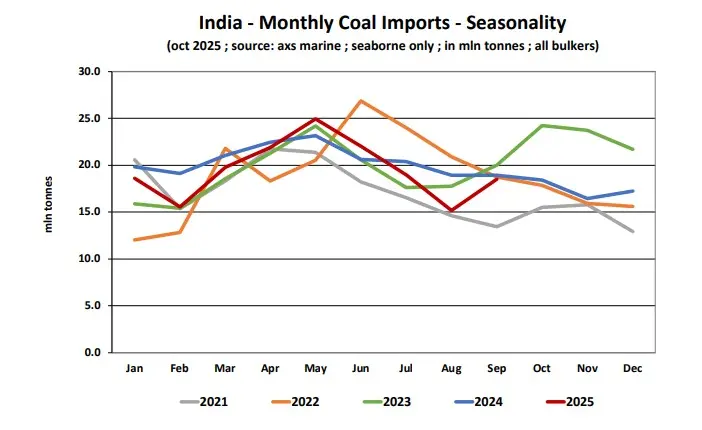
India’s seaborne coal imports fell by 4.9% year-on-year in the first nine months of 2025 to 175 Mt, but the country remains the world’s second-largest importer after China, accounting for over 18% of global seaborne volumes. Data from Bancosta shows a quiet reshaping of India’s supply mix — with Indonesian shipments declining and Russian and South African cargoes rising to record highs, marking a notable shift in trade routes and supplier balance across Asia’s thermal coal market.
In Jan–Sep 2025, global seaborne coal loadings declined by 4.3% year-on-year to 967.4 million tonnes (excluding cabotage), based on vessel-tracking data from AXS Marine.
During the same period, exports from Indonesia fell 9.6% y-o-y to 351.4 Mt, while shipments from Australia slipped 2.2% to 255.4 Mt. Exports from Russia increased 3.5% to 128.6 Mt; from the USA declined 9.6% to 60.4 Mt; and from South Africa grew 6.9% to 46.8 Mt. Shipments from Colombia were down 21.5% to 34.2 Mt, from Canada down 1.4% to 36.3 Mt, and from Mozambique fell 0.8% to 15.8 Mt.
Seaborne coal imports into Mainland China declined 13.0% y-o-y to 263.3 Mt in Jan–Sep 2025. Imports to India fell 4.9% y-o-y to 175.4 Mt, to Japan down 2.4% to 112.2 Mt, and to South Korea down 6.3% to 78.3 Mt. Imports to Malaysia increased 7.5% to 30.8 Mt, and to Vietnam rose 6.3% to 47.2 Mt.
To the EU, imports were up 3.1% to 46.2 Mt, while Turkey fell 4.7% to 26.9 Mt. India remains the world’s second-largest seaborne importer of coal after China, accounting for 18.2% of global seaborne coal trade so far in 2025. Import volumes increased strongly during 2022 and 2023, before slowing in 2024. India imported 225.4 Mt in 2022 (+10.3% y-o-y) and 240.8 Mt in 2023 (+6.9% y-o-y). In 2024, imports declined 1.8% to 236.5 Mt, and have been down 4.9% in the first nine months of 2025.
About 28% of volumes delivered into India in Jan–Sep 2025 were loaded on Capesize vessels, 9% on Post-Panamax, 46% on Panamax, and 16% on Supramax vessels. Roughly 60% of coal imports arrive on the East Coast, primarily in Odisha and Andhra Pradesh. Most of the remainder is discharged in Gujarat, India’s most industrialized state, which alone accounts for 30% of total coal imports.
Main coal import terminals (Jan–Sep 2025):
Mundra (Gujarat) – 22.5 Mt
Paradip – 17.9 Mt
Dhamra – 16.5 Mt
Krishnapatnam – 16.4 Mt
Visakhapatnam – 12.0 Mt
Gangavaram – 11.3 Mt
Hazira – 10.9 Mt
Kandla – 8.2 Mt
Jaigad – 7.8 Mt
Tuticorin – 7.0 Mt
Ennore – 6.3 Mt
New Mangalore – 5.5 Mt
Mormugao – 5.2 Mt
Dahej – 4.1 Mt
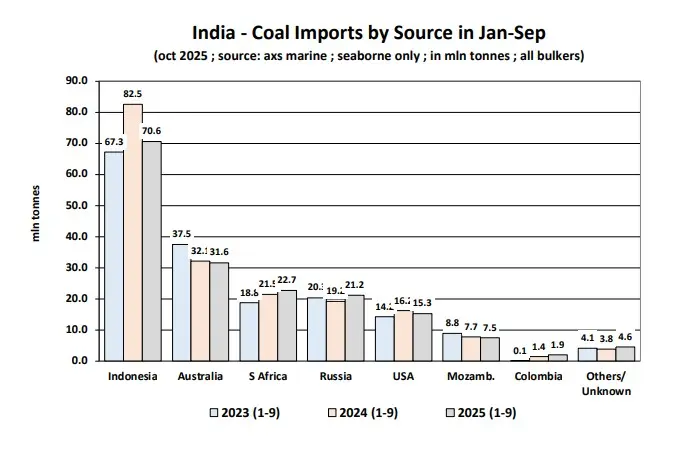
Trade patterns for Indian imports shifted notably due to both commercial and political factors. Indonesia remains the top supplier, accounting for 40.3% of total imports in Jan–Sep 2025. Shipments from Indonesia to India declined 14.4% y-o-y to 70.6 Mt, still above 67.3 Mt in Jan–Sep 2023. Around 18% (31.6 Mt) came from Australia (-1.6% y-o-y). South Africa exported 22.7 Mt (+5.6%), representing 12.9% of India’s imports. Shipments from Russia surged 10.5% to a record 21.2 Mt (12.1% share). Imports from the USA declined 6.0% to 15.3 Mt, while from Colombia rose 38.7% to 1.9 Mt.
As a new entry, India imported 1.1 Mt from Ukraine, up from 0.1 Mt last year.
Data source: Bancosta Weekly Market Report – Week 41 (06–13 October 2025)