

Russian coal exports by rail show a steady negative trend, being in a state of decline for the fifth consecutive year. The total shipment volume plunged from a peak of 224.5 mio t in 2021 to 190.7 mio t in 2025 (-33.8 mio t or -15.1% y-o-y).
This decline is occurring on the back of a completed radical structural shift in logistics. While shipments to the West and East were relatively balanced until 2022, by 2025 a pronounced imbalance had formed: 118.4 mio t of Russian coal is shipped eastward, which is almost double the volume going westward (60.1 mio t).
The share of the eastern direction in the total volume reached a record 62%, firmly cementing its absolute dominance.
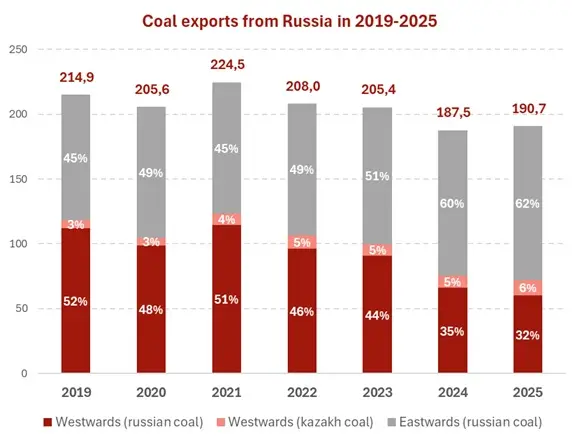
However, the rapid shift to the East has failed to compensate for the collapse of the western market. Shipments of Russian coal westward plummeted by almost half: from 114.6 mio t in 2021 to 60.1 mio t in 2025 (-54.5 mio t or -47.6%). Their share in total export traffic tumbled from 51% to 32%. This is a direct consequence of the EU embargo introduced in August 2022 and the refusal of traditional buyers to accept Russian material.
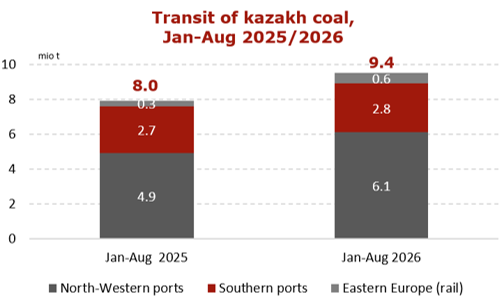
The freed logistics niches in Northwestern ports have been partially occupied by Kazakh coal, which is not subject to sanctions. Its supplies westward are growing steadily, having doubled from 6.3 mio t in 2019 to 12.2 mio t in 2025, with its share of total exports reaching 6%.
Meanwhile, the growth in the eastern direction points to serious systemic constraints. The growth rate of Russian coal shipments to the East in 2024-2025, following the embargo, amounted to only about 6% per year, indicating proximity to the ceiling of the capacity of the Baikal-Amur Mainline and Trans-Siberian Railway.
Thus, coal rail logistics has completed the stage of sharp reorientation and entered a phase of decline, where the infrastructure constraints of the Eastern range do not allow for an increase in volumes sufficient to compensate for losses in the West.
Without an increase in railway capacity on the Far Eastern direction and diversification of routes, the Russian coal industry will be forced to accept a stagnating or declining export potential, which will continue to create long-term limiting pressure on production volumes.
Source: CCA Analysis