Global coal prices were mixed this week, with divergent trends across Europe, China, South Africa, and Australia.
Coal prices showed mixed dynamics: indices in Europe remained stable; in China, coal became cheaper; in Australia, thermal material quotations corrected downwards, while metallurgical prices rose.
European thermal coal market saw heightened volatility. Indices fell to 116 USD/t by midweek, but at the close of Thursday’s trading session, they returned to last week’s level above 121 USD/t. Prices were pressured by a slight increase in ARA stockpiles, as well as rising renewable energy generation. Electricity prices in Germany dropped by an average of nearly 13% over the week to €99.07/MWh. Total wind power generation almost doubled, resulting in the share of renewable energy sources in the country’s generation mix exceeding 60%, while the share of coal-fired generation declined to 19%. However, forward paper contracts became more expensive, resulting in a pronounced contango, which indicates oversold conditions in the spot market or overbought conditions in forward contracts.
Amid escalating conflict in the Middle East, gas quotations on the TTF hub jumped 20.9% to 723.28 USD/1,000 m3 (+124.98 USD/1,000 m3 w-o-w). On March 19, the rally intensified, with prices reaching 800 USD/1,000 m3 intraday, following Israeli strikes on Iran’s main gas field and Iran’s response against an LNG terminal in Qatar. European UGS inventories remained at 29% (compared with 35% a year earlier). Coal stocks at ARA terminals edged up to 2.70 mio t (+0.02 mio t or +1% w-o-w).
South African High-CV 6,000 strengthened again above 113 USD/t due to uncertainty surrounding Indonesian supplies, as well as increased demand from India and the Asia-Pacific region.
Mining company Exxaro expects its South African coal export sales volume to grow 13% to 8.0 mio t this year, as it ramps up shipments to meet rising demand from Japan. Exxaro forecasts export sales in 2026 of 7.3–8.0 mio t, up from 7.1 mio t in 2025, supported by further performance improvements from rail operator Transnet.
Transnet has issued a tender for the lease and operation of three rail lines historically used for coal transportation, marking another step toward expanding private sector participation in South Africa’s rail network. Lease agreements are expected to run for at least 10 years. Bidders will be required to propose investments in infrastructure rehabilitation and modernization, and demonstrate how they plan to improve operational efficiency.
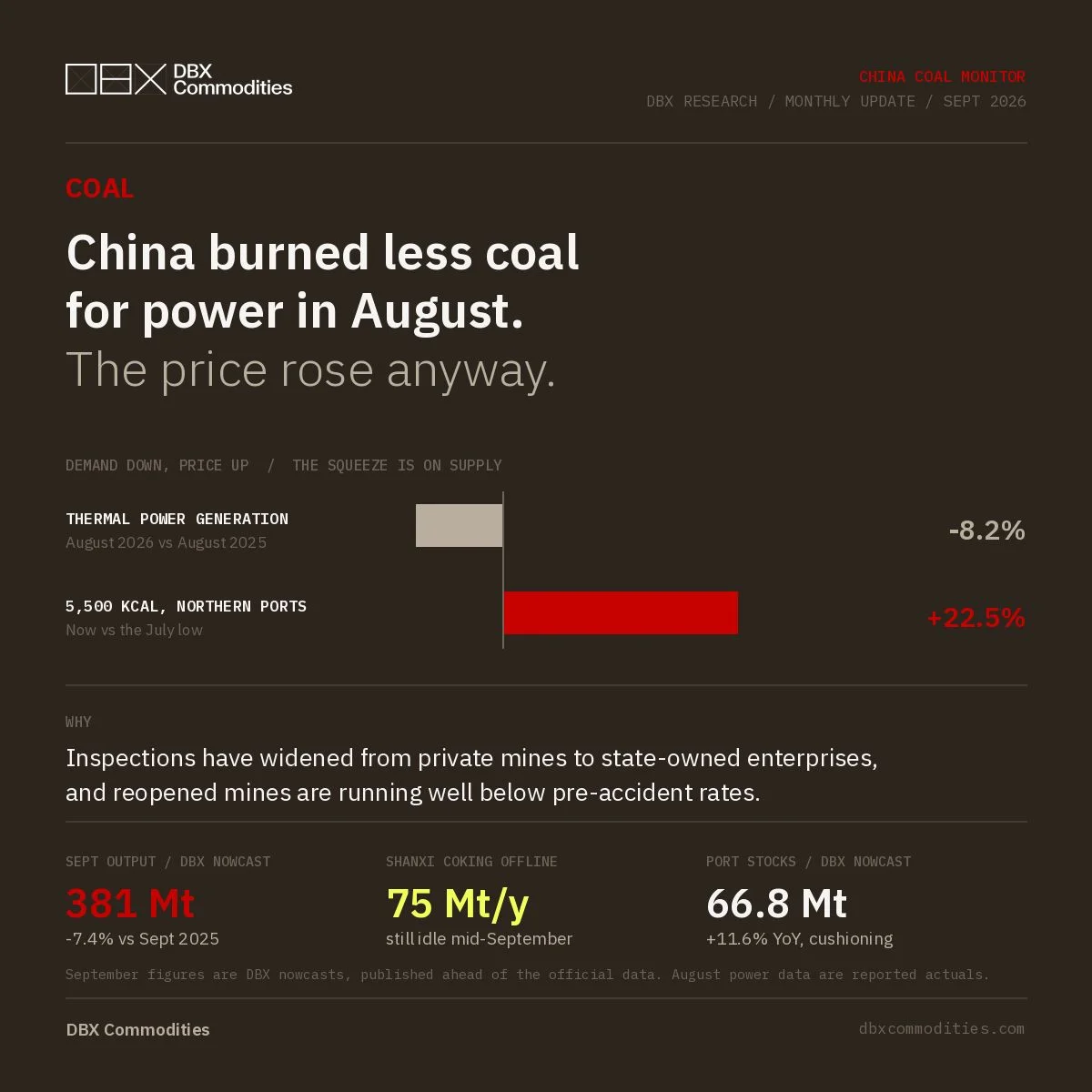
In China, spot prices for 5,500 NAR coal at the port of Qinhuangdao corrected lower to 106 USD/t. Price pressure stems from increased renewable generation and rising stockpiles. Several coastal power companies showed greater interest in domestic spot coal cargoes, but few physical deals were concluded as the power sector entered the spring shoulder season, suggesting further room for price correction.
Stocks at 9 major ports increased to 27.31 mio t (+1.40 mio t w-o-w), while inventories at 6 major coastal thermal power plants rose to 13.12 mio t (+0.20 mio t w-o-w).
Indonesian 5,900 GAR exceeded 92 USD/t, while 4,200 GAR firmed to 60 USD/t. Indonesian material continues to become more expensive due to reduced coal production and export volumes. Nevertheless, buyers showed caution amid disruptions to established trade routes and volatility in freight rates driven by the Middle East conflict, as well as lingering policy uncertainty around production. Market participants in Indonesia began observing Ramadan, which is expected to reduce supply volumes.
Australian High-CV 6,000 edged down to 134 USD/t. Market participants expect demand from South Korea to rise after the country decided to lift caps on coal-fired power generation to ensure energy security amid LNG supply uncertainty. A higher share of coal in South Korea’s power mix could drive prices for high-CV coal higher.
Most potential Chinese buyers held off on purchases, waiting for volatile freight rates (which hit multi-month highs) to stabilize, and given the lack of any meaningful price advantage for imported material.
Australia’s HCC metallurgical coal index reversed course, climbing to 224 USD/t, supported by increased buying interest on the back of concerns that supply of May-loading cargoes could tighten.
Meanwhile, Indian end-users remained unwilling to pay high prices and were demanding discounts off FOB levels, as freight costs have risen substantially. Steel prices in India remained elevated, but thin margins and uncertainty over whether consumers would continue to absorb higher prices kept steelmakers cautious.
Source: CCA