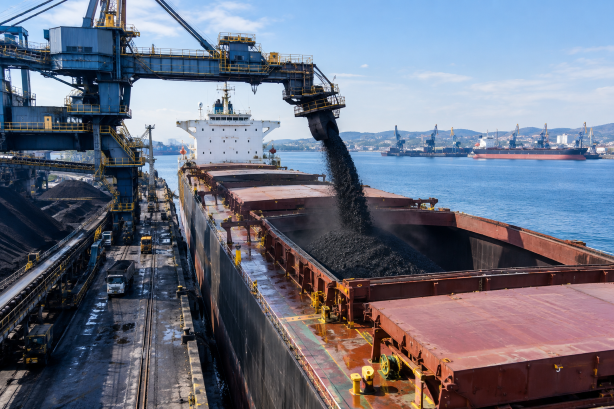
Indonesian coal exports are facing fresh uncertainty after Jakarta announced that all coal exports must pass through a state-owned enterprise from June 1, raising concerns over how the new system could affect margins, operational flexibility and smaller producers already operating with limited financial buffers.
Indonesia announced today that all coal, palm oil and nickel exports must go through a state-owned enterprise from June 1. The operational details are still being worked out. But the cost curve already tells you where the risk sits.
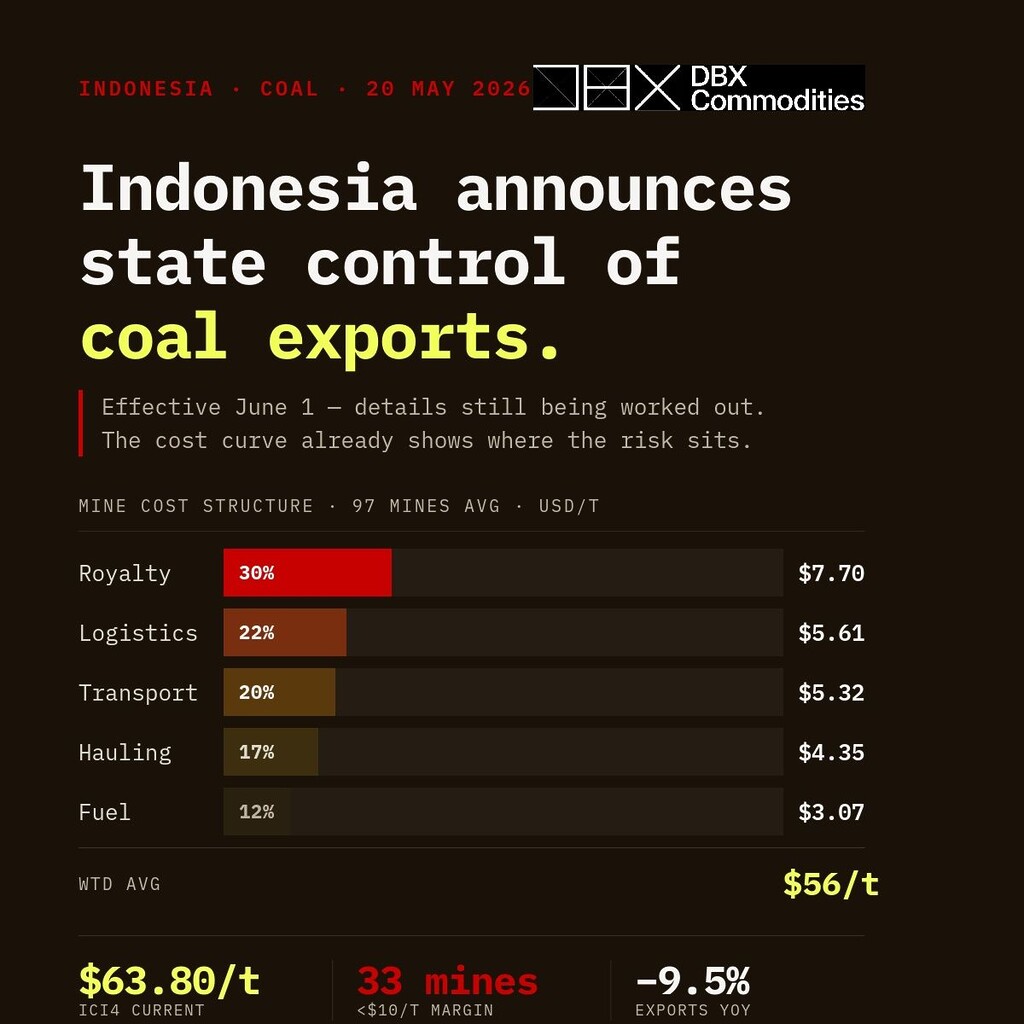
The recovery is real. ICI4 hit a four-year low of $40.68/t in July 2025. By April 2026 it was at $63.80/t — a 57% move in under twelve months. Jakarta tightened RKAB mining quotas and supply discipline held. The sector is in better shape than it was a year ago.
But our flow data adds texture. Indonesian thermal coal exports are running at a 564Mt annualised pace in 2026 — down 9.5% year-on-year. China is taking 13.8% less than this time last year. India 17.0%. The price recovery happened despite softening demand from the two biggest buyers.
That’s a more fragile foundation than the headline price suggests.
Prabowo’s stated goal is to eliminate under-invoicing and enforce full royalty payment — not to extract margin from miners. If the state entity operates as a transparent pass-through, the impact may be limited. But 33 mines in our dataset — 95Mt of output — are profitable today on less than $10/t of margin. They cannot absorb uncertainty the way better-capitalised operations can.
Nobody knows yet exactly how the new export entity will function. Policy uncertainty lands hardest on producers with the least buffer.