Global coal prices showed mixed movements this week across Europe, China, South Africa, Indonesia, and Australia.
The coal market showed mixed dynamics over the week: coal prices in Europe strengthened slightly; prices in China increased; in Australia, high-CV steam coal and metallurgical coal prices softened.
In the European coal market, a downward trend prevailed for most of the week. By April 21, API2 quotes fell below 90 USD/t, but rebounded later to 96 USD/t.
The volatility seen in commodity markets was driven by rapidly changing news surrounding the Strait of Hormuz. On Friday, April 17, Iran declared the strait open, causing a sharp drop in oil, gas, and coal quotes. However, on Monday, April 21, the decision to open was reversed due to the detention of an Iranian cargo vessel by U.S. forces.
Market uncertainty intensified again after Iran stated it was still deciding whether to participate in the next round of peace talks with the United States, following Donald Trump’s decision to extend the truce while maintaining the blockade of the Strait of Hormuz.
According to terminal data, ARA stocks remained flat over the week at 2.85 mio t. Barge deliveries were still under pressure due to low water levels in the Rhine.
Another negative factor for European prices was the decline in coal demand from Turkey amid a sharp increase in hydropower generation. Forecasts indicate that hydropower generation in Turkey could reach a new record in 2026, potentially reducing coal demand by 17% compared to 2025.
Gas prices at the TTF hub, amid uncertainty, rose to 541.42 USD/1,000 m³ by the end of the day on April 23, 2026 (+30.06 USD/1,000 m³ from April 16, 2026). EU underground gas storage facilities are just under 31% full, significantly lower than the 42% recorded during the same period last year.
South African High-CV 6,000 coal index rose above 107 USD/t, supported by demand from alternative markets.
Coal stocks at the Richards Bay Coal Terminal (RBCT) increased over the week to 3.74 mio t. Shipment volumes to India over the past two weeks fell to their lowest level this year — 318,000 t for the period from April 13 to 19. High freight and coal prices forced Indian sponge iron and cement producers to increase their use of local raw materials.
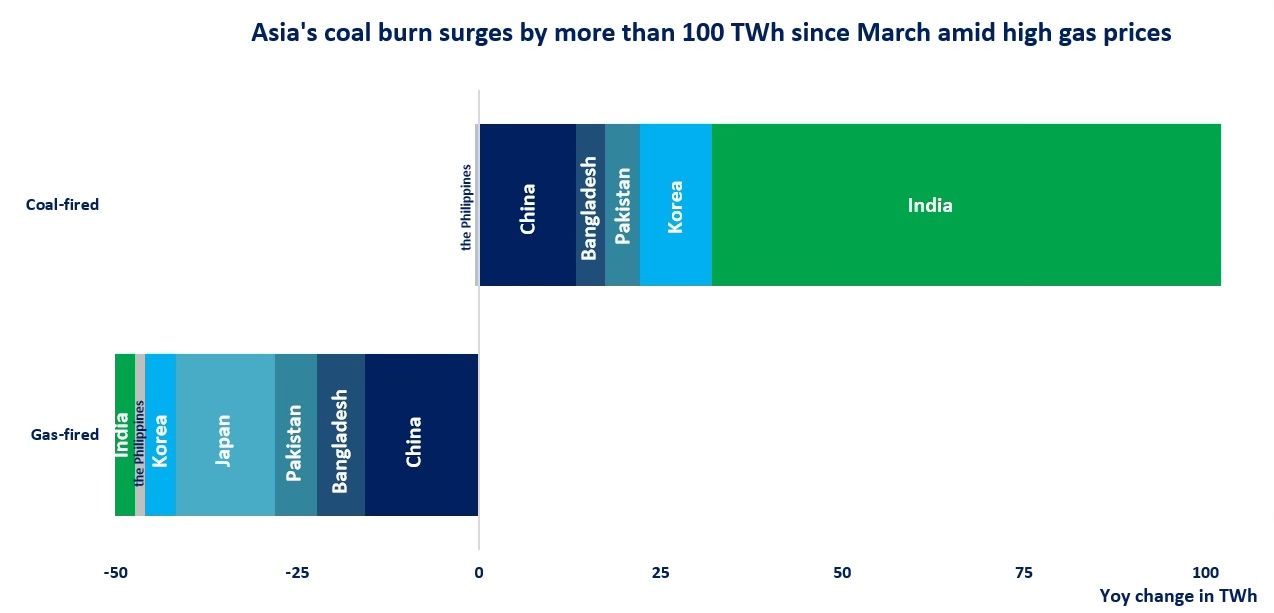
However, demand was observed from other importing countries. For example, 263,000 t of South African coal were shipped to Pakistan last week, marking the highest level this year. An acute shortage of LNG is increasing the country’s dependence on imported coal. According to preliminary data, Pakistan’s seaborne coal imports in April are set to reach a four-year high of 1.2 mio t. A Panamax-sized coal shipment was also sent to Sri Lanka, where a coal shortage linked to material quality fraud has led to reduced power generation.
Taiwan received 142,000 t of South African coal, as wartime disruptions to LNG supplies are forcing the country’s power companies to rely more heavily on coal.
In China, domestic spot prices for 5500 NAR coal at Qinhuangdao port edged up 0.42 USD to 113 USD/t amid stable consumption and declining stockpiles.
The off-season is restraining demand in most regions of China: demand from power sector consumers remains subdued, but industrial consumers, including cement and chemical plants, continue to restock periodically. Compared to last year, coal demand from chemical producers rose by 11% in April, partly due to the impact of the Middle East conflict.
Prices in mining regions remain stable. Traders are awaiting the completion of maintenance on the Daqin railway line, which is expected to lead to a rapid build-up of stocks at northern ports and could put pressure on prices. Several coastal power plants have increased tender volumes to secure supplies for the summer period, as the El Nino, associated with hotter weather, may emerge as early as May according to forecasts.
Coal stocks at nine major ports totaled 27.22 mio t (-0.38 mio t w-o-w), while stocks at six major coastal thermal power plants fell to 12.62 mio t (-0.12 mio t w-ow).
Indonesian 5,900 GAR stood at just over 93 USD/t, while 4,200 GAR material price exceeded 60 USD/t.
In the Indonesian market, trading activity remained subdued amid limited material supply. Inquiries were reported from markets outside China and India for prompt loading cargoes, but offer levels were considered too high to conclude deals.
Concerns have intensified regarding spot fuel availability for barge and truck transportation. Several sources reported emerging difficulties in securing sufficient volumes.
Rainy weather in South Kalimantan continued to affect coal handling and mining for some suppliers, while in Central Kalimantan, the onset of El Nino has lowered river water levels, hampering barge transport of material.
Australian High-CV 6,000 coal price dropped below 125 USD/t, continuing its decline despite gains in the LNG market. Medium-calorific material price strengthened due to demand from Asia-Pacific countries.
Australia’s HCC metallurgical coal index adjusted downward to 230-231 USD/t amid limited liquidity and a lack of new drivers. Traders await India’s return to the spot market to build stocks before the monsoon season. On the other hand, mining companies are not offering excess volumes on the spot market either. Market participants note that supply from several key premium material producers is limited and largely tied to long-term contracts.
Some Indian steel producers have assessed demand for coking coal as low, noting that several plants are undergoing maintenance, and the Middle East war has caused shortages of propane and natural gas, which is also restraining steel production.
Among seaborne market participants, optimism remained regarding a revival of activity in the Chinese market: quotes on the Dalian Commodity Exchange were seen strengthening.
Source: CCA