

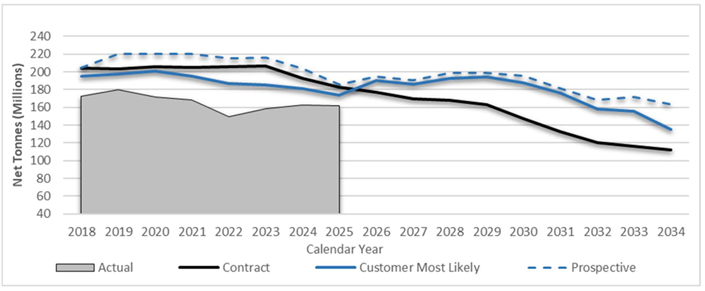
Hunter Valley coal is entering a period of structural decline as contracted export volumes fall sharply through to 2034, reflecting weakening long-term demand for thermal coal. New analysis shows that producers have already reduced contracted volumes by around 40%, a shift that underscores how global energy transitions, tightening environmental regulations and financial pressures are fundamentally reshaping Australia’s largest coal export region.
The latest data reveals a clear turning point. Contract volumes, which remained relatively stable at just above 200 million tonnes per annum until 2023, are now projected to decline steadily through the next decade. As illustrated in the chart from the report, actual production has consistently trailed both contracted and forecast volumes, suggesting that even these reduced commitments may prove optimistic.
This downward trajectory signals more than cyclical weakness—it reflects structural change. Thermal coal demand is increasingly constrained by decarbonisation policies across key export markets. As countries accelerate renewable energy adoption and impose stricter emissions targets, long-term coal contracts are becoming less attractive. The Hunter Valley, long considered a cornerstone of global coal supply, is now directly exposed to this shift.
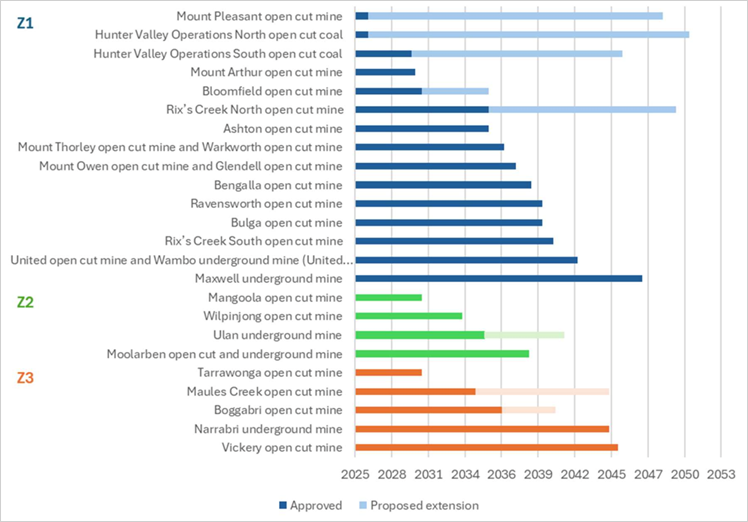
Compounding the issue are tightening environmental approval processes in New South Wales. The state’s coal policy framework increasingly requires projects to demonstrate alignment with net-zero targets, including full assessment of Scope 1, 2 and 3 emissions. This has introduced significant uncertainty around mine extensions and expansions. Several key operations face licence expiries by 2034, and future approvals are far from guaranteed.
The implications for supply chains are profound. Coal export infrastructure in the Hunter Valley—particularly rail and port systems—relies on high, stable volumes to remain cost-effective. As volumes decline, fixed costs are spread over fewer tonnes, driving up per-unit transport costs. This dynamic creates what analysts describe as a “cost death spiral,” where rising costs further reduce economic viability, leading to additional volume declines.
The report highlights how this feedback loop could accelerate mine closures. As access charges rise, marginal operations become uneconomic, forcing earlier shutdowns. In turn, this reduces throughput even further, placing additional strain on infrastructure operators and remaining producers. The risk is not only declining exports, but also stranded assets across the supply chain—from rail networks to port terminals.
Financial pressures are intensifying this trend. Access to debt financing for coal projects is becoming increasingly limited as banks and investors shift away from fossil fuels. Where financing is still available, it comes at higher cost, reflecting elevated risk perceptions. Even infrastructure operators are seeking higher regulated returns to compensate for these financing challenges.
This evolving financial landscape reinforces the structural nature of the decline. Higher capital costs, combined with regulatory uncertainty and shrinking demand, are eroding the economic foundation of long-term coal production. Producers are already responding by scaling back commitments and accelerating debt repayments while prices remain supportive—an indication of declining confidence in future profitability.
Importantly, the projected 40% reduction in contracted volumes may understate the scale of the challenge. If stricter environmental approvals lead to the rejection of key mine extensions, export volumes could fall even faster. This raises serious questions about the long-term viability of existing supply chains and the strategic direction of the Hunter Valley coal industry.
Looking ahead, policymakers and industry stakeholders face difficult decisions. The cost dynamics outlined in the analysis suggest that extending mine life may not deliver the expected economic benefits, particularly if infrastructure costs continue to rise. At the same time, the growing risk of stranded assets underscores the need for careful planning around mine rehabilitation and regional economic transition.
Ultimately, the decline in Hunter Valley coal contracts marks a decisive shift in Australia’s energy export landscape. What was once a stable, high-volume system is now entering a phase of contraction, driven by structural forces that are unlikely to reverse. The coming decade will test the resilience of the region’s coal-dependent economy and determine how effectively it can adapt to a rapidly changing global energy market.
source: IEEFA