

U.S. coal production moved lower in the latest weekly report from the Energy Information Administration, with output declining week over week while still holding a modest lead over the comparable 2025 period on a year-to-date basis.
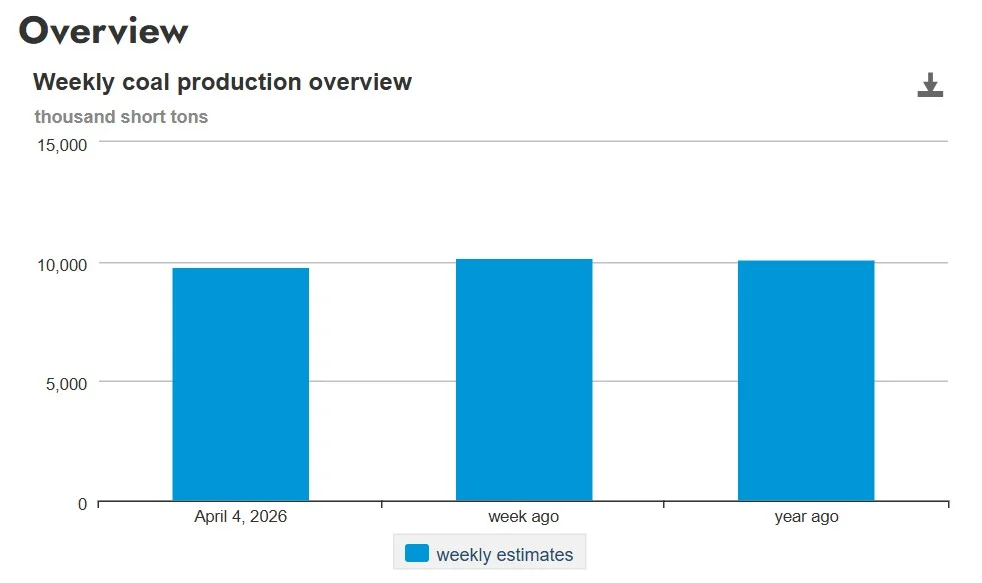
For the week ended April 4, 2026, U.S. coal production totaled 9.765 million short tons, down from 10.168 million short tons in the previous week. In the same week last year, production stood at 10.134 million short tons.
Despite the weekly decline, cumulative output for the year remained slightly higher than last year. Through April 4, 2026, U.S. coal production reached 138.763 million short tons, compared with 138.316 million short tons during the same period in 2025, an increase of 0.3%.
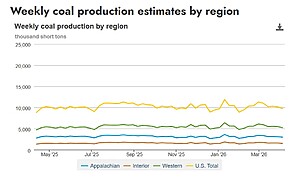
The Western region continued to account for the largest share of U.S. coal production, with 5.245 million short tons produced during the week. The Appalachian region followed with 2.997 million short tons, while the Interior region contributed 1.523 million short tons.
On a year-to-date basis, the West remained the main source of growth. Western coal production totaled 74.755 million short tons, up 2.6% from the same period last year. Appalachian production also posted a gain, rising 1.5% to 42.257 million short tons. The Interior region, however, continued to lag, with output falling 8.8% year over year to 21.751 million short tons.
At the state level, Wyoming retained its position as the country’s largest coal-producing state by a wide margin. The state produced 3.880 million short tons during the week and 54.950 million short tons year to date, up 4.4% from the comparable 2025 period.
West Virginia ranked second with weekly output of 1.563 million short tons, though its year-to-date production of 22.014 million short tons was down 1.5% from last year. Pennsylvania produced 797 thousand short tons during the week and remained one of the stronger performers on a cumulative basis, with year-to-date output up 8.5% to 11.176 million short tons.
In the Interior region, Illinois produced 629 thousand short tons for the week, but year-to-date output fell 14.8% to 8.968 million short tons. Indiana also remained below year-ago levels, down 8.9% year to date.
Among the more notable gainers, Utah continued to show strong momentum, with year-to-date production rising 24.6%. Alabama was up 9.5%, while Texas and Wyoming also posted gains from the same point last year.
Overall, the latest EIA data points to a softer production week for U.S. coal, but not yet a weaker year. The national total remains narrowly ahead of 2025, supported primarily by gains in the West and select Appalachian states.