Colombian coal remains under pressure despite the election of a more market-friendly government. New analysis suggests that while recent policy changes and stronger coal prices may support margins in the short term, export flows, freight economics and market access continue to present significant challenges for the country’s coal sector.
Colombia just elected a market-friendly, pro-fossil-fuel president. The easy read is “bullish for coal.”
But seaborne flow data says: not so fast.
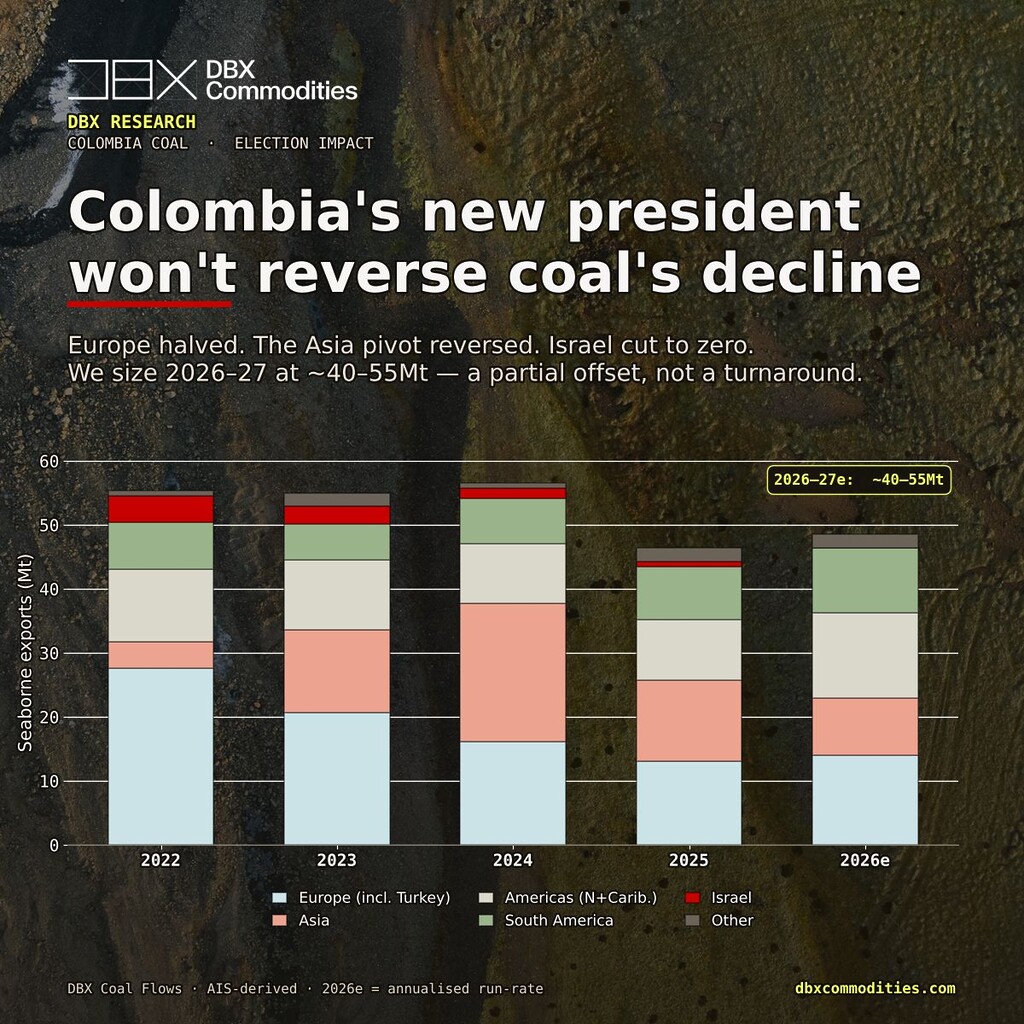
The new government does remove a policy headwind. It could reopen the Israel export corridor — a ~4Mt/yr destination cut to zero by decree in 2025, still shut today. And an LNG/Hormuz-driven price rally is firming margins right now.
But none of that reverses the structural picture:
Europe, Colombia’s core market, has more than halved since 2022 — 27.6Mt to 13.1Mt
The 2023–24 pivot to Asia didn’t hold; a ~$35/t freight gap (vs ~$7 Indonesia, ~$15 Australia) keeps Colombian cargo uncompetitive east of Suez
Exports fell to 46.4Mt in 2025, the steepest drop in a decade — and 2026 is tracking ~48Mt
On the cost curve, Drummond (~$70/t) and Cerrejón (~$75/t) ship >90% of volume; everything above ~$85/t is idle, and stays idle
The read-through: a destination-mix re-rating and a margin floor for the low-cost incumbents — not a production revival. A friendlier government draws capital to copper, gold and transition minerals, not new thermal-coal mines.