Global coal prices moved in different directions last week, with firmer values in Europe, softer spot prices in China, and continued strength in Australian metallurgical coal.
Over the past week, European thermal coal indices on the spot market firmed above 103 USD/t, resulting from weather forecasts, which promise Europe consistently cold weather through the end of January and temperatures 4 degrees below the climatic norm in February.
Furthermore, fossil fuel generation in Germany accounted for about 60% of output, compared with 53% a week earlier, while the share of renewables was 40% versus 47% the previous week.
The last coal mine in the Czech Republic, owned by state company OKD, will be shut down at the end of January this year, given low prices and Europe’s energy transition, ending a 250-year history of underground coal mining in the country. In 2025, the mine produced about 1.15 mio t (-0.05 mio t y-o-y).
Gas quotations on the TTF hub rose to 492.27 USD/1,000 m3 (+28.79 USD/1,000 m3 w-o-w). European UGS inventories fell by another 4 percentage points to 45%. Coal stocks at ARA terminals decreased over the week to 3.10 mio t (-0.34 mio t or -10% w-o-w).
South African High-CV 6,000 climbed above 94 USD/t, while Mid-CV material recovered to 81 USD/t because of steady demand from Indian sponge iron producers. The market found some support from logistical disruptions to shipments of alternative grades from Indonesia and Australia.
Furthermore, due to severe floods, state rail operator Transnet declared force majeure on coal export shipments via the Northeast Rail Corridor through Mozambique.
Some South African producers were also affected, as floodwaters impacted coal stockpiles along railway lines and at the mining operations themselves. At the same time, the southern region of South Africa did not experience significant flood impact.
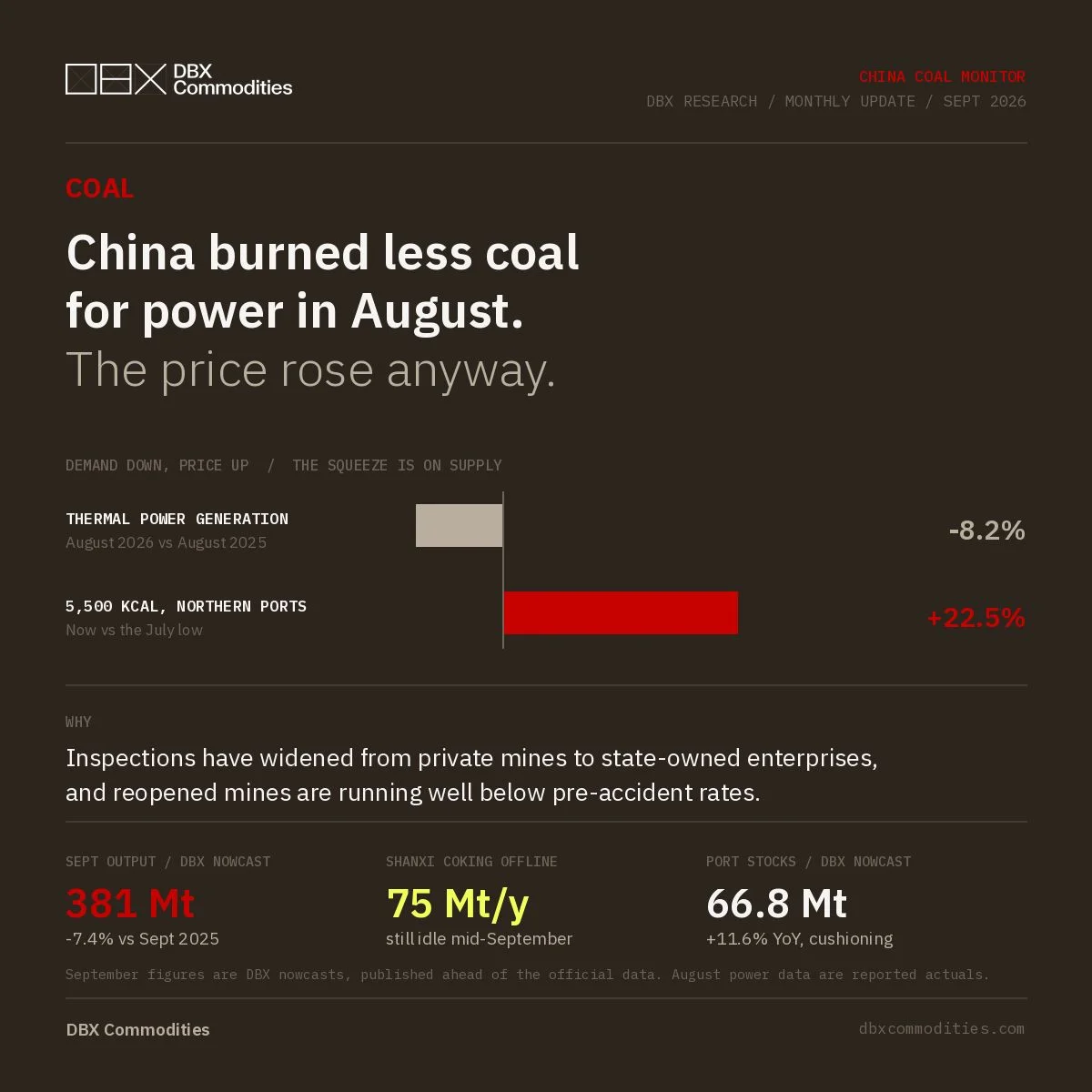
In China, spot prices for 5,500 NAR coal at the port of Qinhuangdao fell below 100 USD/t but have already begun to find support amid shrinking stockpiles.
Railway tariffs for coal transportation from Inner Mongolia were sharply reduced, following similar measures in Xinjiang, as Chinese provinces intensify efforts to compete for the domestic coal market.
Unlike Xinjiang, which directs its material to inland regions, Inner Mongolia ships a significant portion of its coal to coastal power plants, putting it in direct competition with imports.
Signs of a weakening import market are already evident, with traders viewing domestic tariff reductions as an additional short-term negative factor for seaborne supplies against a backdrop of slow pre-Lunar New Year restocking.
Stocks at 9 major ports decreased to 25.75 mio t (-1.32 mio t w-o-w), while inventories at 6 major coastal thermal power plants fell to 13.25 mio t (-0.08 mio t w-o-w).
Indonesian 5,900 GAR settled above 82 USD/t, while 4,200 GAR increased to 47.5 USD/t.
Indonesian material again became more expensive because of logistical constraints and supply shortages from some regions of Indonesia and Australia. The reduction in supply is due to rough seas and torrential rains in parts of South Kalimantan. Combined with persistent logistical issues in South Sumatra, this has led to limited availability of spot cargoes.
Additionally, the closure of the Mahulu Bridge in Samarinda (Kalimantan) for inspection after a collision with a coal barge on January 25 has caused partial delays in transshipment.
Meanwhile, Indonesian suppliers were unwilling to accept a premium below 2-3 USD/t, as uncertainty regarding the upcoming coal export levy and post-first-quarter production volumes makes sales planning difficult for producers.
Australian High-CV 6,000 corrected below 111 USD/t, while prices for Mid-CV material improved to 74-75 USD/t.
Spot market activity was subdued because of public holidays in Australia and India, also aided by limited consumption and relatively high inventories in some North Asian countries, which pressured buyer interest amid a warmer-than-expected winter.
Australia’s HCC metallurgical coal index jumped above 250 USD/t. The upward trend in metallurgical coal quotations continued.
Demand still exceeds supply, pushing prices to their highest levels in the last 1.5 years.
However, some end-users are beginning to adopt a wait-and-see attitude, considering the current price level to be high. Furthermore, Chinese purchases for restocking ahead of the New Year are gradually coming to an end.
Source: CCA Analysis