Italy coal phase-out plans are under scrutiny as a proposed delay to 2038 risks increasing system costs without delivering meaningful price relief.
A proposed extension of Italy’s coal phase-out to 2038 is raising concerns over cost, policy alignment and market relevance. The amendment, introduced within the Energy Bills Decree currently under approval, comes at a time when some global markets are reconsidering coal use due to energy security concerns and gas price volatility.
However, Italy’s situation differs fundamentally from these markets.
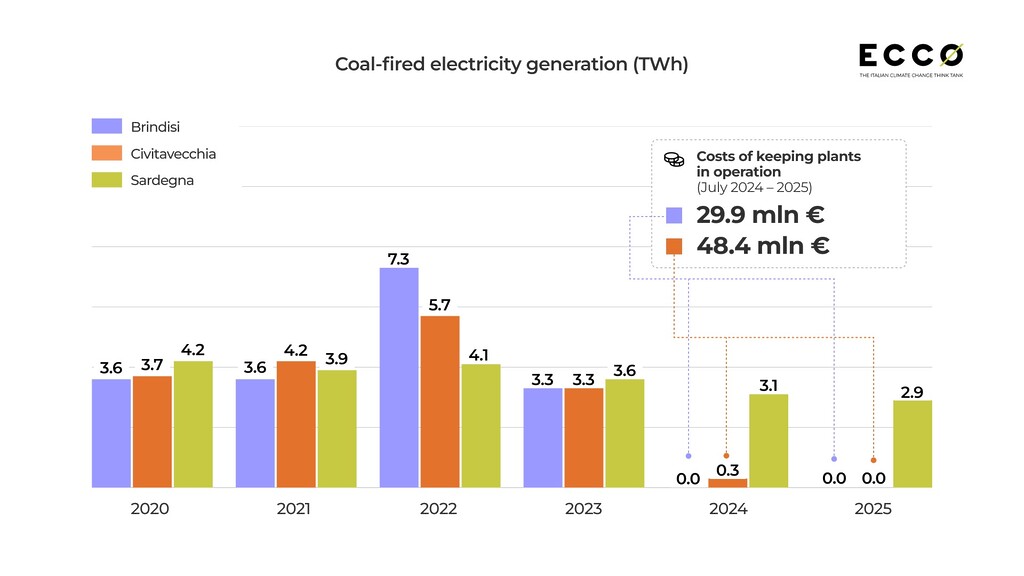
Coal-fired generation in Italy has already been largely phased out on economic grounds. Mainland plants such as Brindisi and Civitavecchia are effectively idle, with generation falling to near zero by 2025. Coal accounted for just 1.1% of total electricity generation in 2025, equivalent to 2.9 TWh.
Remaining coal capacity is concentrated in Sardinia, where plants continue operating under a regulated “essential service” regime.
These units are not economically competitive and rely on full cost recovery mechanisms linked to system security needs rather than market viability.
Structural factors continue to undermine any potential return of coal in Italy:
- Coal plants are excluded from the capacity market
- High carbon costs under the EU ETS increase marginal generation costs
- Lower efficiency compared to gas-fired generation
- Expired environmental permits requiring complex reauthorisation
As a result, coal-fired generation cannot deliver electricity at prices below gas, and extending operations would likely increase system costs. Maintaining plants between mid-2024 and mid-2025 already resulted in costs of approximately €78 million.
The proposed delay also appears misaligned with Italy’s broader energy strategy. The country has already secured system adequacy through the capacity market and now requires accelerated investment in renewables, grid infrastructure and storage.
At a policy level, extending coal use risks creating friction with EU climate objectives, including the Green Deal and commitments to phase out coal by 2035 across G7 economies.
More broadly, the measure highlights a structural issue within Italy’s power market: high electricity prices remain primarily driven by gas dependency rather than coal availability.
At the same time, renewable deployment is slowing, with capacity additions falling by around 7% in 2025. Regulatory uncertainty around permitting, grid connections and auction frameworks continues to delay investment.
In this context, delaying the Italy coal phase-out is unlikely to deliver lower electricity prices and may instead:
- Increase costs for consumers
- Slow renewable investment
- Reinforce exposure to fossil fuel volatility
Source: ECCO