

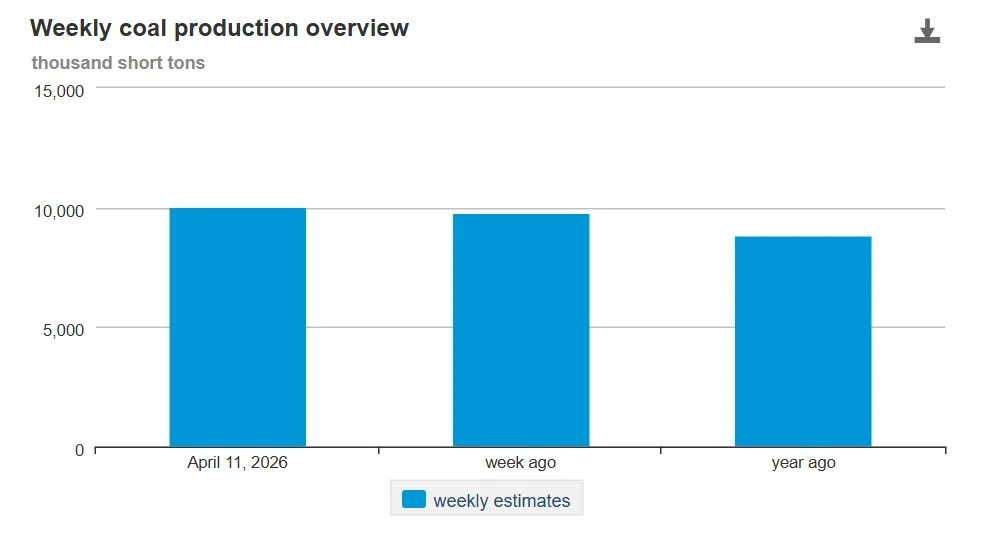
U.S. coal production moved higher in the latest EIA weekly release, with total output reaching 10.019 million short tons in the week ended April 11, 2026, up from 9.765 million short tons a week earlier and above 8.823 million short tons in the comparable week last year.
On a year-to-date basis, U.S. coal production stood at 148.783 million short tons, compared with 147.289 million short tons a year earlier. EIA’s published weekly table also shows the 52-week total at 528.770 million short tons, up from 515.596 million short tons a year earlier.
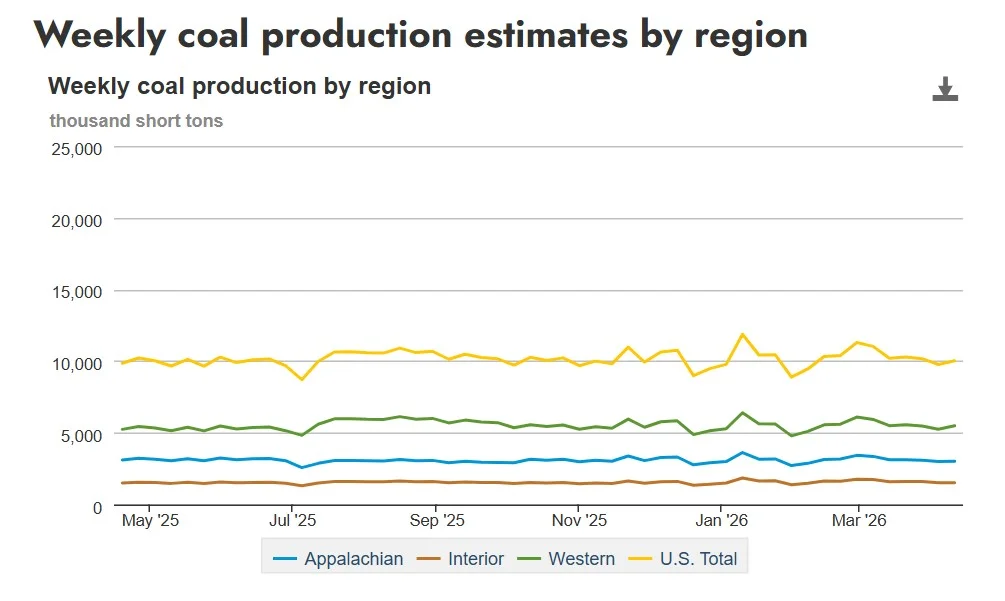
Regionally, the Western coalfields remained the main driver of U.S. supply. Western production totaled 5.493 million short tons for the week, while the Appalachian region produced 3.012 million short tons and the Interior region added 1.515 million short tons.
Year to date, Western production reached 80.248 million short tons, up 3.4% from a year earlier, while Appalachian output rose 1.8% to 45.269 million short tons. The Interior region continued to lag, with year-to-date production down 7.7% to 23.265 million short tons. These regional groupings and EIA’s methodology notes are set out in the agency’s weekly coal production table.
At the state level, Wyoming remained by far the largest producer, with weekly output of 4.193 million short tons and year-to-date production of 59.143 million short tons, up 5.3% from the same period last year. West Virginia followed with 1.544 million short tons for the week, though its year-to-date total of 23.558 million short tons was 0.9% below last year.
Pennsylvania produced 818 thousand short tons during the week and continued to outperform on a cumulative basis, with year-to-date production up 8.2%. Illinois produced 629 thousand short tons for the week, but its year-to-date output was down 13.4%, while Utah continued to post one of the strongest growth rates, up 24.4% year to date. These figures come from the latest EIA weekly production workbook you provided.
Coal shipments by rail also increased. EIA’s weekly table shows 58,309 railroad cars loaded in the latest week, compared with 56,069 the previous week and 51,600 in the corresponding week last year. Year to date, railroad cars loaded totaled 842,588, up 3.0% from 818,119 a year earlier, although EIA notes that rail carload estimates are not exact for the same time periods and are not prorated to a daily basis.
The latest weekly report should be read as a high-frequency snapshot rather than a final monthly total. EIA notes that coal production is prorated to a daily basis, while railroad carload figures are not, making the weekly series most useful for tracking short-term production direction and regional shifts in supply. The agency also notes that monthly coal production estimates are usually released during the first full week of the following month.