Global coal prices showed mixed momentum last week, falling across Europe and Australia while rising in China.
Negative sentiment prevailed in the coal market: prices in Europe fell again; in China, coal became more expensive; in Australia, thermal and metallurgical quotations declined notably.
European thermal coal indices continued to slide below 93 USD/t. Price pressure stemmed from falling gas and oil quotations amid easing tensions in the Middle East. The convergence of US and Iranian positions on extending the ceasefire regime, along with Israel’s plans to discuss a potential truce with Lebanon, reduced concerns over risks to oil and gas supplies.
Additionally, pressure on quotations came from higher coal stocks at ARA terminals, driven by increased shipments and falling water levels on the Rhine River. Thermal coal off-take from Colombia rose 51% to 1.33 mio t from 0.89 mio t the previous week. The primary destination for Colombian thermal coal was EU countries.
Meanwhile, German coal-fired power plants returned to profitability amid rising electricity prices and lower renewable generation. Renewables’ share of Germany’s power mix fell to 48% from 69% the previous week, while the share of fossil fuels rose to 52% from 31%.
Gas quotations on the TTF hub dropped to 511.36 USD/1,000 m3 (-26.08 USD/1,000 m3 or -4.9% w-o-w) due to favorable weather conditions and optimism surrounding a new round of US-Iran negotiations.
South African High-CV 6,000 weakened below 102 USD/t, following European indices. However, Richards Bay quotations proved more resilient due to demand from importers, including Indian cement producers who switched from petcoke to coal because of the closure of the Strait of Hormuz.
Coal exports through the RBCT terminal in Q1 2026 rose 9% to nearly 15.85 mio t from 14.55 mio t in the same period a year earlier. Consequently, RBCT could ship around 63 mio t for export in 2026, up from 57.66 mio t in 2025, exceeding the annual target of 60 mio t. The primary growth driver was India, which increased imports by 29% or 1.85 mio t to 8.35 mio t compared with 6.50 mio t in Q1 2025.
South African antitrust authorities approved the sale of the Goedehoop North Collier coal mine to GHN Resources, paving the way for a change of ownership of this export-oriented coal asset in Mpumalanga province. Last year, Goedehoop North exported 2.6 mio t of coal, but the operation has been idle since December 2025.
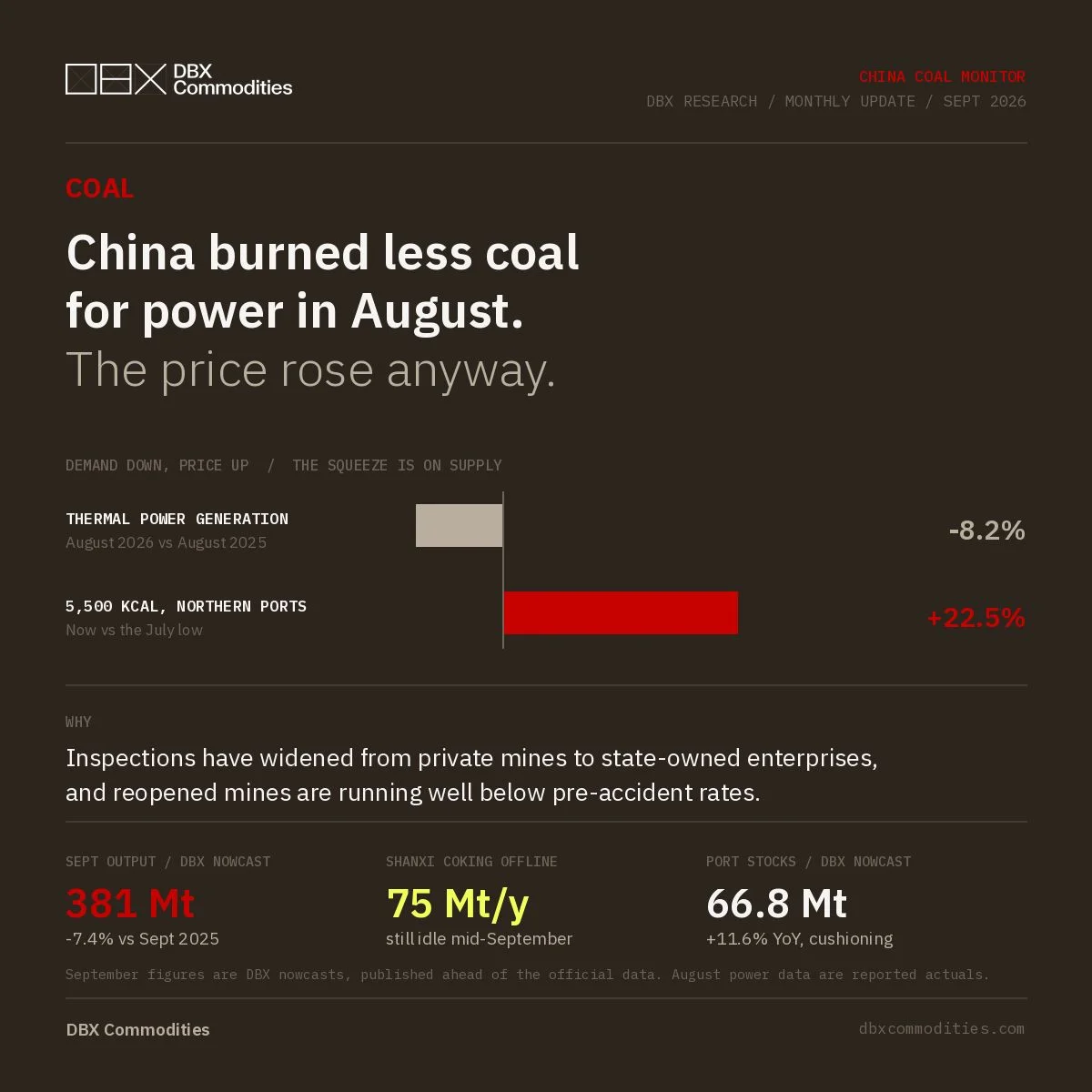
In China, spot prices for 5,500 NAR coal at the port of Qinhuangdao strengthened to 112 USD/t due to declining port inventories. Additionally, ongoing maintenance on the Daqin rail line, hot weather in the south, and external market uncertainty also provided support to domestic quotations. China’s largest coal supplier, Shenhua Group, repeatedly raised procurement prices for third-party suppliers across all grades. Some spot market participants interpreted the price hikes as a positive short-term signal, prompting traders to hold prices firm.
Coal stocks at 9 major ports fell to 27.60 mio t (-0.59 mio t w-o-w), while inventories at 6 major coastal thermal power plants remained nearly unchanged at 12.74 mio t (-0.03 mio t w-o-w).
Indonesian 5,900 GAR held steady at 93 USD/t, while 4,200 GAR also remained flat at 60 USD/t. Many Indonesian coal companies limited spot cargo offerings, as their primary focus is on fulfilling existing contracts in both domestic and export markets. China and India focused on consuming their own low-CV material, while other Asian countries, including Vietnam, sought to purchase coal from Australia.
Meanwhile, Indonesian authorities raised reference prices for thermal coal (HBA index) across all grades for the second half of April due to persistent supply constraints, despite the approval of annual production quotas.
Australian High-CV 6,000 fell sharply below 130 USD/t in response to de-escalation of the Middle East conflict. Meanwhile, Mid-CV 5,500 firmed slightly above 88 USD/t on demand from the Asia-Pacific.
Australia’s HCC metallurgical coal index declined to 231 USD/t, continuing its downward trend as supply exceeded demand and buyers adopted a wait-and-see stance, anticipating further correction.
Additional pressure came from the availability of more competitively priced alternative material from the US. In China, buying interest in imports weakened last week as a correction in futures markets dampened sentiment, despite higher steel production.
Nevertheless, sentiment among some traders turned somewhat more optimistic amid expectations of restocking in India ahead of the monsoons.
Source: CCA