Global coal prices declined over the past week amid weaker sentiment across major coal markets.
Negative sentiment prevailed in the coal market over the past week: indices in Europe declined significantly; coal in China remained unchanged; in Australia, high-CV thermal and metallurgical coal became cheaper.
In the European coal market, the downward movement intensified over the past week. Quotations fell below 118 USD/t. Pressure on coal came from a sharp drop in gas and oil prices of nearly 20% following the announcement of a US-Iran agreement with the signing of a memorandum of understanding that allowed for the unblocking of the Strait of Hormuz. The deal helped ease concerns over potential energy supply disruptions, though the US president warned that military action could resume if Iran fails to meet its commitments.
Gas quotations on the TTF hub fell to 487.14 USD/1,000 m3 (-73.63 USD/1,000 m3 w-o-w). EU underground gas storage increased to 45% (+2 ppts w-o-w), notably below last year’s level of 53%.
South African High-CV 6,000 dropped below 108 USD/t, following European quotations. Market participants refrained from trading amid volatility. Interest in South African coal from India remained limited due to weak sponge iron prices over the past six weeks. Meanwhile, rail deliveries of coal for export were recovering after Transnet completed repairs on rail lines damaged on June 8 by a derailment. Both lines were reopened late last week.
Exports through the RBCT terminal in May rose 13% month-on-month. However, June volumes are expected to be lower due to the derailment. Rail deliveries were suspended for approximately four days, causing deliveries to the RBCT terminal to fall significantly below the norm (1 mio t per week). Still, RBCT could ship around 62 mio t for export for the full year (+7.5% vs. 2025), exceeding the 60 mio t target.
In China, spot prices for 5,500 NAR coal at the port of Qinhuangdao remained flat at 127 USD/t due to persistent buyer resistance to higher prices, which led to reduced activity and limited transactions, although suppliers remained confident about mid-summer demand.
Under long-term thermal coal contracts, daily consumption and procurement volumes continued to rise alongside higher generation loads. Overall, trader sentiment was mixed. Some participants maintained high price expectations, supported by tightening supply at the mining level and expectations of peak seasonal demand. Conversely, others were increasingly inclined to sell due to rising inventories, sufficient availability of prompt-delivery import cargoes, and falling import coal prices.
On June 15, Chinese authorities mandated that nine key coal-consuming sectors (power generators, steel, aluminum, cement producers, etc.) carry out upgrades in 2026–2028 to improve energy efficiency by an average of 20%. The goal is to reduce coal consumption by 100 mio t/year and cut CO₂ emissions. Inefficient capacity is expected to be phased out gradually.
Coal stocks at 9 major ports edged down to 28.33 mio t (-0.11 mio t w-o-w), while inventories at 6 major coastal thermal power plants stood at 13.97 mio t (+0.24 mio t w-o-w).
Indonesian 5,900 GAR rose above 109 USD/t, while the price of 4,200 GAR strengthened to nearly 67.5 USD/t. Demand for Indonesian material from Chinese consumers is rising amid tighter safety inspections, following the May 22 tragedy in Shanxi.
The upward trend in Indonesian material quotations continues. However, price gains are slowing alongside demand in India and China, where coal supply and inventory levels are high.
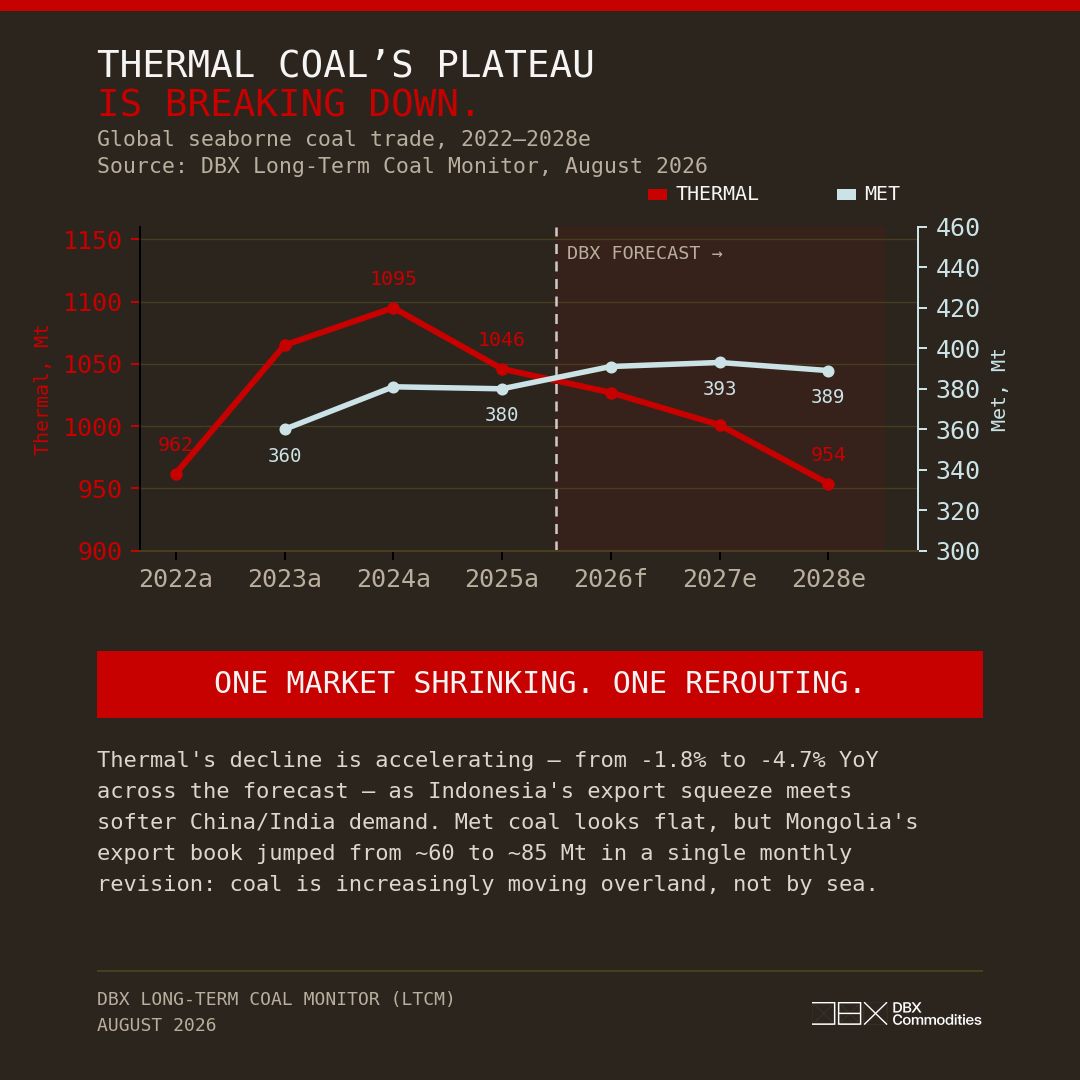
Indonesian coal exports recovered over the past week thanks to increased shipments to India and other countries, while exports to China remained broadly stable. Loading in Kalimantan and Sumatra also remained relatively smooth. Preliminary data shows exports reached 8.8 mio t (+14% w-o-w and +6% y-o-y), above the 24-week average of 8.4 mio t. In the first 24 weeks of 2026, Indonesia shipped 202 mio t of coal (-18 mio t or -8% y-o-y).
Australian High-CV 6,000 fell to 141 USD/t, retreating from a 20-month high following de-escalation of the Middle East conflict. Additionally, Australia’s Bureau of Meteorology declared the onset of El Nino, which could support increased production and exports by Australian mining operations.
Australia’s HCC metallurgical coal index corrected below 244 USD/t as buyers adopted a wait-and-see stance and interest from India remained absent. Still, some market participants expect trading activity to pick up from China, as PLV CFR China prices continued to find support from strengthening domestic market prices.
Source: CCA