Bearish sentiment persists on the coal market: prices in Europe dropped to a 6-month low (92.4 USD/t) and then rebounded above 94 USD/t; prices in China corrected downward; in Australia, High-CV and Medium-CV material became cheaper, while metallurgical coal prices continued to decline.
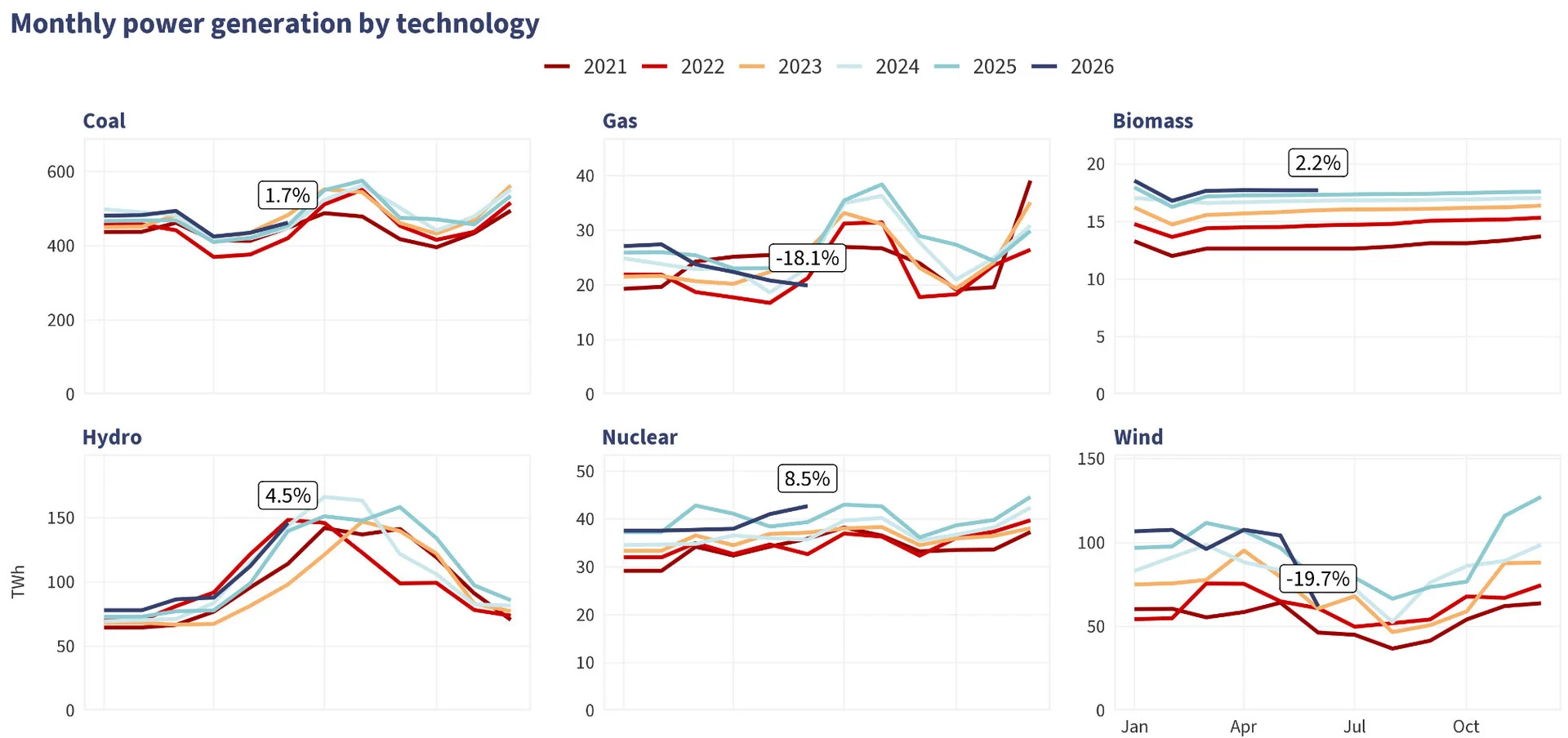
Over the past week, European thermal coal indices saw high volatility. Quotations hit a 6-month low on the back of sufficient coal stocks at ARA terminals, falling temperatures, reduced consumption as well as increased renewable generation.
Nevertheless, a rebound above 94 USD/t happened after the French company EDF was forced to reduce capacity at its nuclear power plants on account of low water levels, which heightened reliance on coal and gas.
The German federal agency BNetzA stated that new bans on coal consumption will not be introduced in Germany in 2025, given that coal power plant closures have already exceeded the capacity reduction targets set for 2028. Coal capacities were decommissioned faster than anticipated by the coal phase-out law.
Gas quotations on the TTF hub also edged up to 390.19 USD/1,000 m³ (+0.83 USD/1,000 m³ w-o-w). Storage facilities are 78% full (+2 p.p. w-o-w). Injection rates remain above 2024 levels. However, Norwegian gas supplies are set to decline over the next three weeks, as Norwegian gas infrastructure undergoes scheduled maintenance. Coal stocks at ARA terminals decreased to 3.48 mio t (-0.03 mio t w-o-w).
South African High-CV 6,000 managed to hold at 85 USD/t (a 4-month low), which revived demand from Indian buyers, who concluded several deals (one of them for a Capesize shipment at a discount to the API4 index).
In China, spot prices for 5,500 NAR coal at the port of Qinhuangdao fell by 2 USD/t to 97 USD/t, following a prolonged yet moderate strengthening. Pressure on prices was exerted by a contraction in consumption and a drop in electricity demand owing to cooler weather in the country’s central and eastern regions, starting September 01. Activity on coal markets was subdued, as the nation’s attention was focused on celebrations for the 80th anniversary of the victory over Japan and the end of World War II.
However, a document published beforehand by the local development and reform commission of Shaanxi province did attract market participants’ attention, who expect the industry overall to tighten control over production in order to stabilize the market during the off-season.
Meanwhile, local officials have been instructed to enhance the monitoring of production, inventories, sales, and the fulfillment of long-term contracts. Nevertheless, such measures are not necessarily going to lead to a significant rise in coal prices, since reserve capacities are intended specifically for price stabilization by ensuring timely coal supplies.
Inventories at the 9 largest ports fell to a new annual low of 22.47 mio t (-0.61 mio t w-o-w). Coal stocks at the 6 largest coastal TPPs totaled 13.41 mio t (-0.08 mio t w-o-w), while consumption dropped to 922 kt/day (-19 kt/day w-o-w).
Indonesian 5,900 GAR remained at 75 USD/t, whereas the price of 4,200 GAR declined to 42.5 USD/t. Supply of 5,900 GAR material stayed limited, which provided some support. However, weakening demand from China pushed down 4,200 GAR coal quotations, and producers were forced to lower prices for this material to clear their stockpiles. Market participants anticipate that after the monsoon season ends in September-October, India will return to the market, and this will prevent Indonesian exporters from reducing prices further.
The Indonesian authorities have temporarily suspended the coal mining accounting system (MODI) and are transitioning it to the digital MinerbaOne platform. This will not cause export disruptions, but an element of uncertainty is present.
Australian High-CV 6,000 plunged below 108 USD/t because of decreased demand and falling quotations in the Atlantic region. Partial pressure also came from a nearly 75% surge in US thermal coal exports over the week.
More significant decline is being prevented by factors such as the demand from Japan, fueled by heat as well as growing vessel queues at Australian ports and the repair and replacement of ship loaders at several terminals.
Australia’s HCC metallurgical coal index dipped to 185 USD/t amid limited demand. In July, metallurgical coal prices rose rapidly, which caused concern among buyers. In August-September, the market entered a correction phase. Furthermore, Canadian suppliers reduced quotes and increased exports, which intensified competition in the Asian market, while logistics issues in Australia are not outweighing the weakness in demand.
Source: CCA Analysis