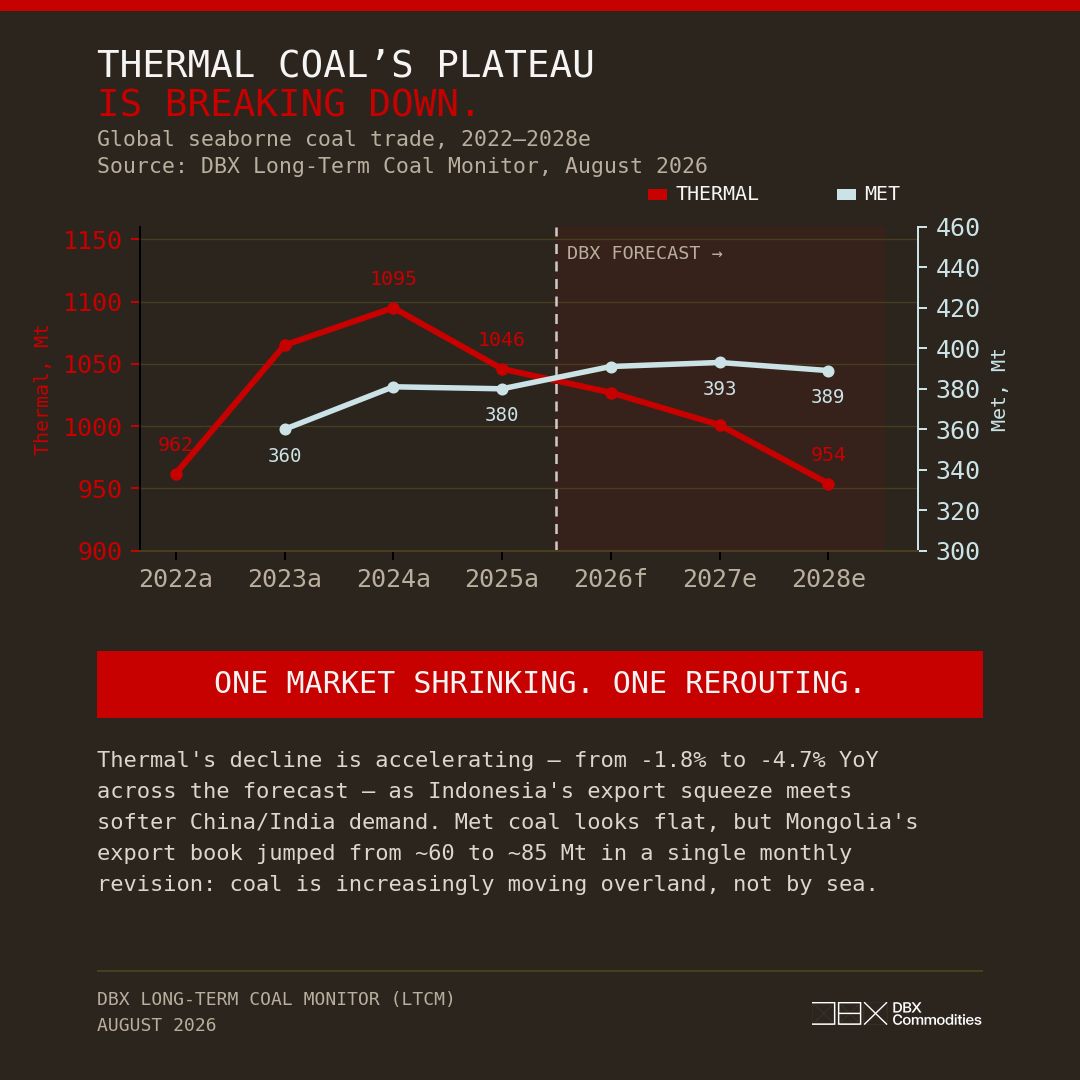
Global coal prices moved in different directions over the past week, with firmer values in Europe, softer spot prices in China, and continued strength in metallurgical coal markets. Price movements reflected a mix of regional demand trends, weather impacts, gas market volatility and supply-side constraints across key exporting regions.
Overall price increases were seen in the coal market: indices in Europe corrected downwards; in China, coal became more expensive; in Australia, quotations for both thermal and metallurgical material rose.
Over the past week, European thermal coal indices on the spot market corrected slightly below 102 USD/t. Increased volatility was noted last week due to sharp gas price fluctuations, lower electricity costs, the Indonesian government’s announcement of production cuts, and the release of new forecasts predicting significant warming. The profitability of coal-fired generation was -10.23 EUR/MWh, compared to a profit of 3.39 EUR/MWh. Fossil fuel generation last week accounted for about 55% of Germany’s power output, down from a previous 60%, while the share of renewables grew from 45% to 58%. Electricity prices in Germany dropped from 121.72 EUR/MWh to 102.44 EUR/MWh (-19.28 EUR or -16%).
Gas quotations on the TTF hub fell from local highs of around 520 USD/1,000 m3 recorded during the week to 408.75 USD/1,000 m3 (-65.62 USD/1,000 m3 or -14% w-o-w). European UGS inventories fell by another 5 percentage points to 40%, though pipeline gas supplies from Norway increased. Coal stocks at ARA terminals edged up slightly to 3.11 mio t (+0.01 mio t w-o-w).
South African High-CV 6,000 rose above 95 USD/t (reaching a 2-month high), finding support from demand from India and uncertainty surrounding Indonesian supplies.
South Africa’s RBCT coal terminal is expected to increase its export throughput to 65 mio t this year, supported by a significant rise in rail transportation, efforts to combat cable theft, and investments in automation system upgrades. In its annual forecast, RBCT projected export volumes of at least 60 mio t but intends to exceed this target, especially after a 10% rise in exports last year to 57.7 mio t.
MC Mining announced it will suspend operations at the Uitkomst mine, which produces high-CV coal, from March. Key reasons include losses and negative cash flow due to low prices, a significant drop in coal production and sales, a 32% increase in production costs to 116 USD/t, as well as adverse geological conditions and equipment wear. Simultaneously, the company is developing the strategic Makhado coking coal project.
In China, spot prices for 5,500 NAR coal at the port of Qinhuangdao found support and rebounded to 101 USD/t against a backdrop of declining stockpiles. An additional growth driver was Indonesia’s decision to sharply cut coal production and reduce producer export quotas by 30–70%, which directly threatens supplies to China. Average temperatures in the country over the next ten days are forecast to be 1–3°C above seasonal norms, with mid-February readings expected to be 2–4°C above usual levels.
Consumers in China’s power and non-power sectors have largely completed restocking, while coal production is decreasing due to small mine closures, which is expected to support prices until the holidays.
Stocks at 9 major ports fell to 24.81 mio t (-0.94 mio t w-o-w), while inventories at 6 major coastal thermal power plants remained at 13.30 mio t (unchanged w-o-w).
Indonesian 5,900 GAR climbed above 83 USD/t, while 4,200 GAR increased to nearly 48 USD/t. Indonesian material again became more expensive because of logistical constraints, supply shortages, and the official announcement of the Indonesian government’s plans to sharply cut production in 2026, which could amount to 15-80% for different producers and aims to support prices. According to some estimates, a 20% production cut could raise export prices for Indonesian coal by 40–70% for low-CV grades and by 10–20% for high-CV grades. Consequently, the coal producers’ association has called on the government to reconsider these plans, warning of serious risks, including contract breaches and plant shutdowns.
Simultaneously, authorities in South Sumatra have temporarily exempted several Indonesian coal companies from the existing ban on coal transport via the region’s public roads. The ban, introduced on January 1, following a bridge collapse in June linked to coal haulage, has been partially eased for a limited number of producers for one month. Meanwhile, dozens of other companies remain in uncertainty, maintaining force majeure status since the start of the year.
Australian High-CV 6,000 coal strengthened notably above 114 USD/t following the announced Indonesian government plan to reduce production.
The upward trend in metallurgical coal quotations continued. Australia’s HCC metallurgical coal index exceeded 252 USD/t. Demand still exceeds supply. Some market participants anticipate increased activity from India.
A forward benchmark for Australian Low-Vol PCI for Q1 2026 was set between Foxleigh and Nippon Steel at 163.75 USD/t FOB (+15.75 USD/t versus Q4 2025 and +9.25 USD/t versus Q1 2025).
Source: CCA