


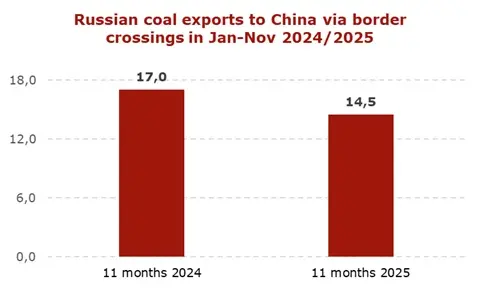
Russian coal exports by rail to China dropped sharply in November, marking their lowest monthly level since 2023. In January-November 2025, Russian railway coal exports to China via border crossings fell to 14.5 mio t (-2.5 mio t or -14.7% vs. Jan-Nov 2024).
Shipments in November dropped to 1.0 mio t, hitting their lowest level since 2023 and marking a 23% decrease vs. October and a 38% contraction year-on-year.
The decline was driven by a combination of weaker demand in Chinese northern provinces and persistent logistical bottlenecks on the Eastern Range. Furthermore, Russian exporters have shifted a growing share of supplies toward more profitable seaborne deliveries, where CFR price gains in recent months have significantly outpaced overland DAP pricing.
While border crossings shipments retained a competitive edge in August due to lower transportation costs, the widening CFR-DAP price spread by late November made seaborne deliveries far more economically attractive.
In addition to price pressure and muted demand, Russian suppliers faced more constraints from limited railway capacity towards Chinese border points.
The state-owned Russian Railways (RZD) approved only 60% of the applications for cross-border shipments, filed by Russian mining companies in November.
The situation underscores a deeper, systemic issue: a long-standing shortage of rail transport capacity on the Baikal-Amur Mainline (BAM) and Trans-Siberian Railway has led to exports being heavily dependent on the infrastructure of a monopoly, which still lags significantly behind market requirements.
Source: CCA Analysis