


Russian coal exports are gaining support from South Korean demand as the country increases coal and nuclear power generation.
In January–May 2026, South Korea doubled its coal imports from Russia to 10.2 mio t (+5.0 mio t or +96.2% vs. Jan–May 2025).
South Korea’s total coal imports in January–May 2026 surged to 46.8 mio t (+7.6 mio t or +19.4% vs. Jan–May 2025).
Because of the energy crisis in the Middle East, South Korea is lifting the 80% cap on coal-fired power plant capacity utilization and increasing nuclear power plant capacity utilization from the current 65–70% to 80%. With rising prices and supply risks for imported LNG and oil, coal and nuclear power generation are strengthening their positions in the country’s energy mix.
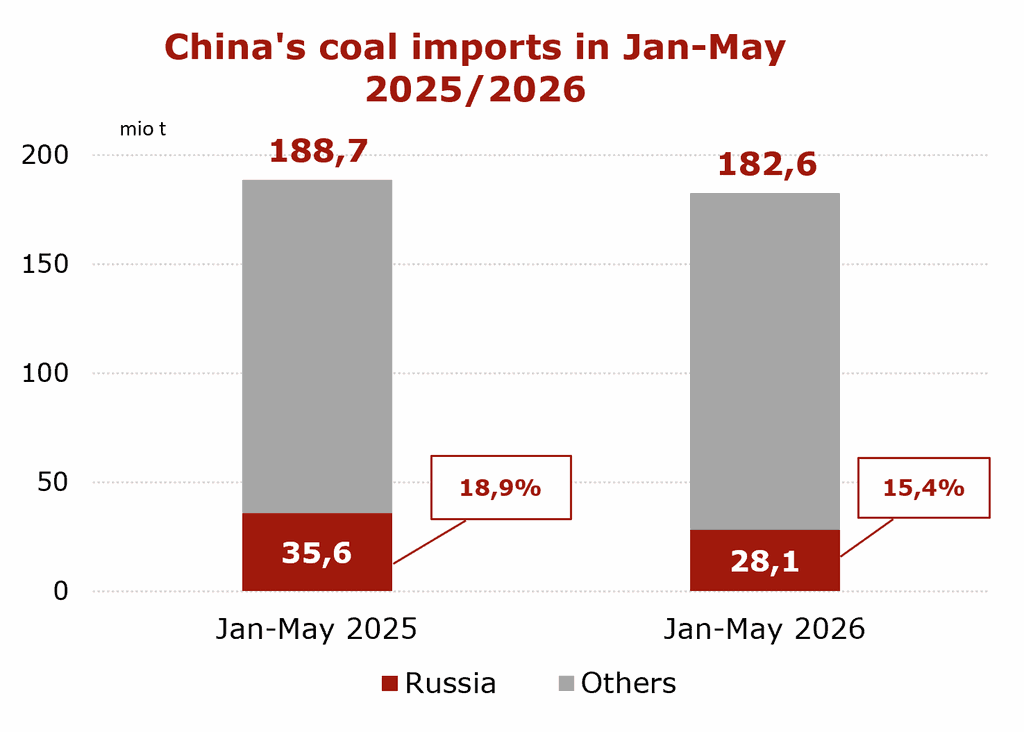
Furthermore, El Nino is expected to bring an unusually hot summer with record-breaking demand for electricity. Combined with the need to replenish reserves ahead of winter and ongoing disruptions in global LNG supplies, this will drive South Korea to sharply ramp up its thermal coal imports. Under these conditions, South Korea will likely be forced to import thermal coal in 2026 at volumes significantly exceeding the levels seen in the first five months.
South Korean coal imports (Jan–May 2026):
· Australia: 15.3 mio t (+3.0 mio t or +24.4% y-o-y);
· Russia: 10.2 mio t (+5.0 mio t or +96.2% y-o-y);
· Indonesia: 10.1 mio t (-0.2 mio t or -1.9% y-o-y);
· Canada: 4.6 mio t (+1.1 mio t or +31.4% y-o-y);
· South Africa: 2.3 mio t (+0.3 mio t or +15.0% y-o-y);
· Colombia: 2.1 mio t (-0.3 mio t or -12.5% y-o-y);
· USA: 1.1 mio t (-1.0 mio t or -47.6% y-o-y).
Given the crisis in the Russian coal industry, South Korea remains strategically important due to comparatively higher prices than other key markets like China and India.
The unprofitability of Russian coal exports keeps growing because of expensive logistics and a strong ruble. Still, producers are trying to maintain their market share, owing to the quality of their material and expectations of better conditions in the medium term, including stabilization of global prices after they hit rock bottom, as well as the expected correction of the ruble exchange rate.
Source: CCA