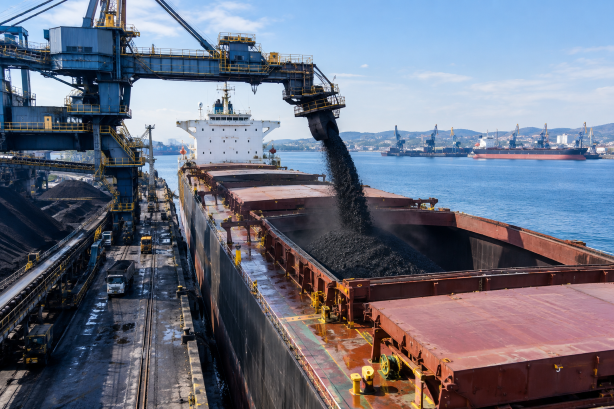
Global coal market showed mixed dynamics: indices in Europe corrected downwards; in China, coal became more expensive; in Australia, thermal material quotations moved in different directions, while metallurgical prices declined again.
Over the past week, European thermal coal indices corrected downwards to 105 USD/t, having briefly held at the one-year high level. CO2 emission allowances became more expensive, and coal spreads turned even more negative at -5.75 EUR/MWh, compared to -4.69 EUR/MWh a week earlier.
The share of fossil fuel generation in Germany decreased to 44% (versus 58% last week), while the share of renewable energy sources rose from 42% to 56%.
Representatives of energy-intensive industries in the European Union, in a joint policy document, outlined their vision for the future Electrification Action Plan, calling primarily for a reduction in prohibitively high electricity costs that render them uncompetitive.
The European Steel Association Eurofer, which has long pointed to the negative impact of high prices on production profitability in the region, also joined this initiative.
Gas quotations on the TTF hub fell to 388.54 USD/1,000 m3 (-5.12 USD/1,000 m3 w-o-w). European UGS inventories declined by 2 percentage points to 31%.
South African High-CV 6,000 decreased to 99 USD/t, following the price correction in Europe. Mid-CV material found significant support from uncertainty surrounding Indonesian supplies and demand from India.
South African mining company Menar plans to raise approximately 248 million USD in financing to acquire locomotives needed to transport nearly 10 mio t of coal and manganese ore annually, as it seeks to become one of the country’s first private rail operators. To attract investment, Menar insists on revising regulations to include service level commitments and compensation in case of non-fulfillment of obligations by the infrastructure operator.
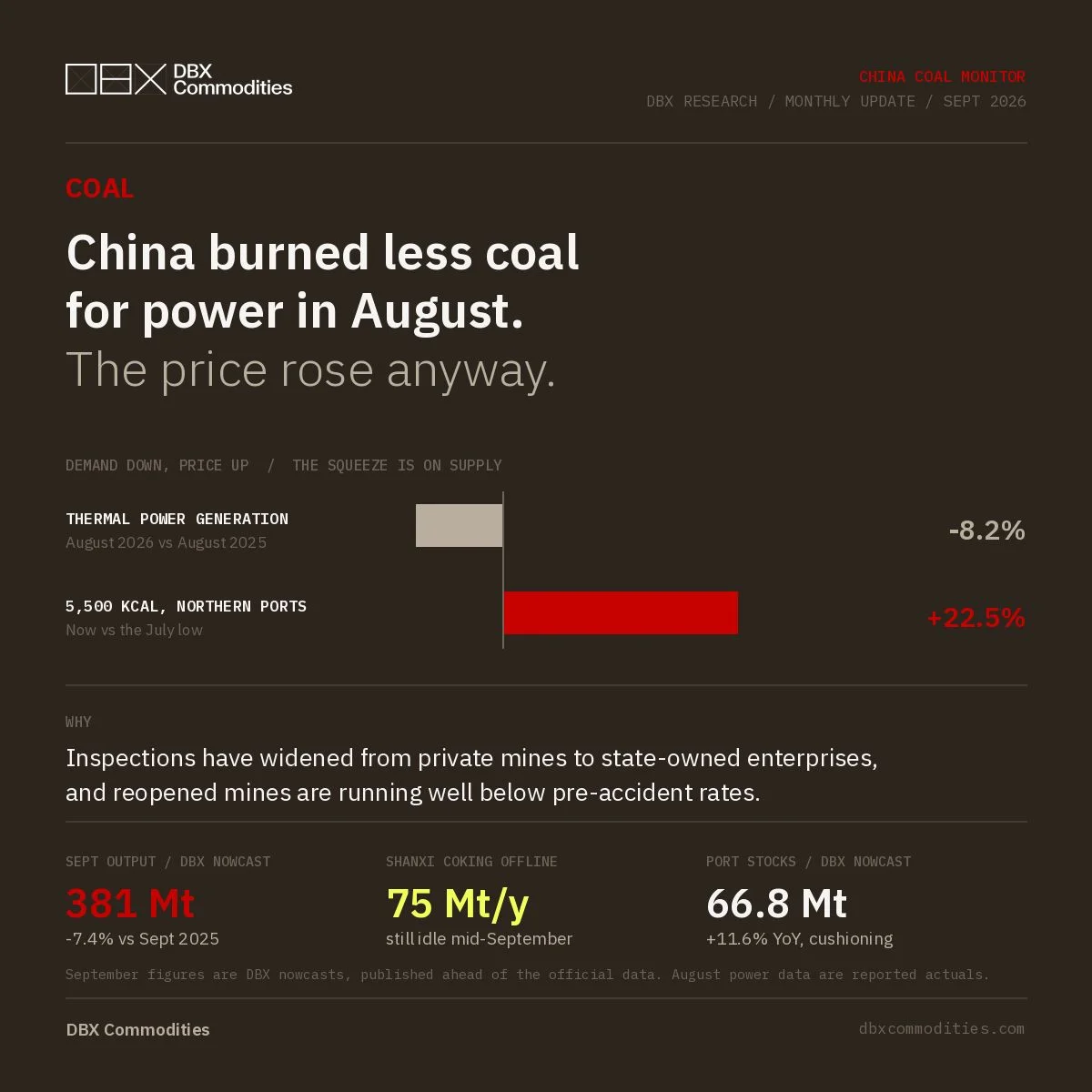
In China, spot prices for 5,500 NAR coal at the port of Qinhuangdao rose to 104 USD/t. The upward trend in domestic Chinese market quotations continued after the Chinese New Year celebrations ended, as demand exceeds supply amid reduced available volumes at ports and concerns over tonnages from both domestic sources and imports in the near term. Limited supply may persist for some time, given that many small mining enterprises will remain closed until March 3, and mine safety will be a priority during the session of the National People’s Congress (March 5-15).
Stocks at 9 major ports fell to 23.44 mio t (-0.51 mio t w-o-w), while inventories at 6 major coastal thermal power plants increased to 13.82 mio t (+0.38 mio t w-o-w).
Indonesian 5,900 GAR continued its rise to 87 USD/t, while 4,200 GAR climbed to 53 USD/t, due to the political decision to reduce coal production volumes in the country. Demand from India is also providing support. Prolonged rains, exacerbating production and logistical problems, are further intensifying mining companies’ concerns. Despite Indonesian coal being offered with rapidly rising premiums, firm bids were few. It is assumed that supply is coming mainly from those suppliers whose production volumes apparently will not be cut by the government. Although traders have available cargoes, most are waiting for further price increases, as stocks held by the majority of producers are nearly sold out.
According to preliminary official data, coal production in Indonesia in January amounted to 46 mio t, the lowest monthly figure since January 2022 (44.53 mio t), when production was affected by a 28-day export ban. Market participants in India and Southeast Asia report that preliminary discussions are already underway to assess alternative supply sources from Australia, South Africa, Russia, and the US in case production cuts are confirmed.
Australian High-CV 6,000 corrected below 116 USD/t, retreating from the 6-month high. Meanwhile, Mid-CV material jumped to nearly 87 USD/t, supported by limited supply of Indonesian material and rising demand from India’s metallurgical sector, power generators, and cement producers.
Australia’s HCC metallurgical coal index continued its downward movement, dropping to 241 USD/t, resulting from weakening demand. Because of the bearish trend, some buyers are seeking to conclude deals based on the index rather than a fixed price.
The recent decline in interest in Australian coal is partly related to growing expectations of cheaper coke supplies to India, as well as the persistence of alternative offers from the US and Canada. Consequently, Indian consumers have adopted a wait-and-see stance.
Source: CCA