Global coal prices moved higher over the past week as supply disruptions, stronger Asian demand, and rising energy prices supported the market.
Over the past week, coal market upward movement gained traction: European indices spiked; coal prices kept climbing up in China; in Australia, thermal coal quotations strengthened significantly, as did metallurgical coal.
In the European coal market, quotations exceeded 133 USD/t, with prices rising nearly 8% during the week reaching 137 USD/t, followed by a downward correction. Coal prices were pushed upward by a combination of factors: the declaration of force majeure by Colombian exporter Cerrejon due to a railway blockade, the suspension of talks between the US and Iran amid mutual strikes on Middle Eastern infrastructure, which led to higher oil and gas prices.
Additional support came from the replenishment of coal stocks at ARA terminals and the UN announcement of a high probability of a strong El Niño, which would lead to above-normal temperatures in many countries this summer.
Colombian coal producer Cerrejon suspended mining, rail transport, and loading at its export terminal on June 1. According to some reports, the company has already resumed operations and lifted force majeure the following day; however, unloading was carried out directly from railcars to vessels, as port coal stocks were exhausted on Monday following the railway blockade that began on May 23.
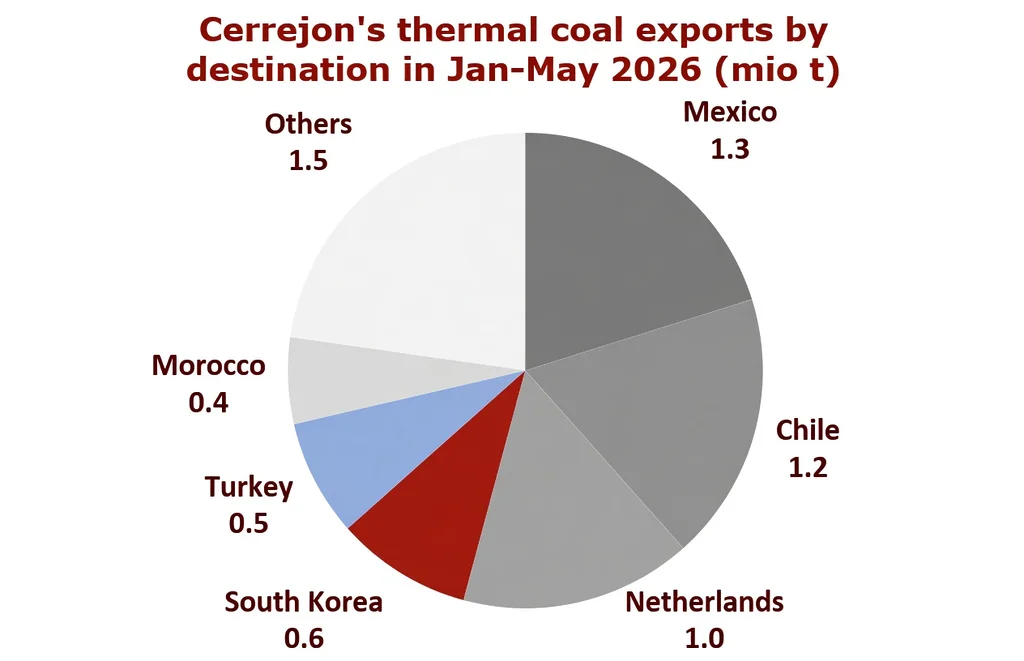
Around 40% of Cerrejon’s export shipments go to Latin American countries. In other markets, the company’s supplies are not a determining factor. For example, its volumes do not exceed 4% in the Turkish market and 2% of steam coal imports in South Korea.
Gas quotations at the TTF hub on June 4, 2026, closed at 585.13 USD/1,000 m³ (+28.42 USD/1,000 m³ w-o-w). Gas inventories in EU underground storage increased to 41% (+2.2 percentage points w-o-w).
South African High-CV 6000 rose to 121-122 USD/t and settled at its highest level in 2.5 years. Support for the indices continues to come from rising prices in Europe, uncertainty regarding exports from Indonesia, and demand from Japan, Taiwan, and South Korea. However, mid-CV 5500 coal dipped slightly to just below 96 USD/t due to weakening demand from Indian sponge iron producers, who are facing low prices for their products, high production costs, and are switching to local material.
Operator Transnet confirmed that repair work on the second line between the Iswepe and Wildrand sections has been completed, allowing rail service to the Richards Bay Coal Terminal (RBCT) to resume after a train derailment on June 2 halted traffic. Market participants expect this event will not significantly impact coal rail freight volumes this week. Coal stocks at the South African RBCT terminal have remained above the 4 million tonne threshold for the third consecutive week.
In China, spot prices for 5500 NAR coal at Qinhuangdao port rose to 125 USD/t. Prices in the Chinese domestic market strengthened. Electricity demand in southern China set four consecutive daily records between May 25 and 28, driven by sustained economic growth and abnormally early high temperatures. Thus, the record period arrived 45 days earlier than last year. Consequently, the load on cooling systems across the region increased significantly earlier than usual.
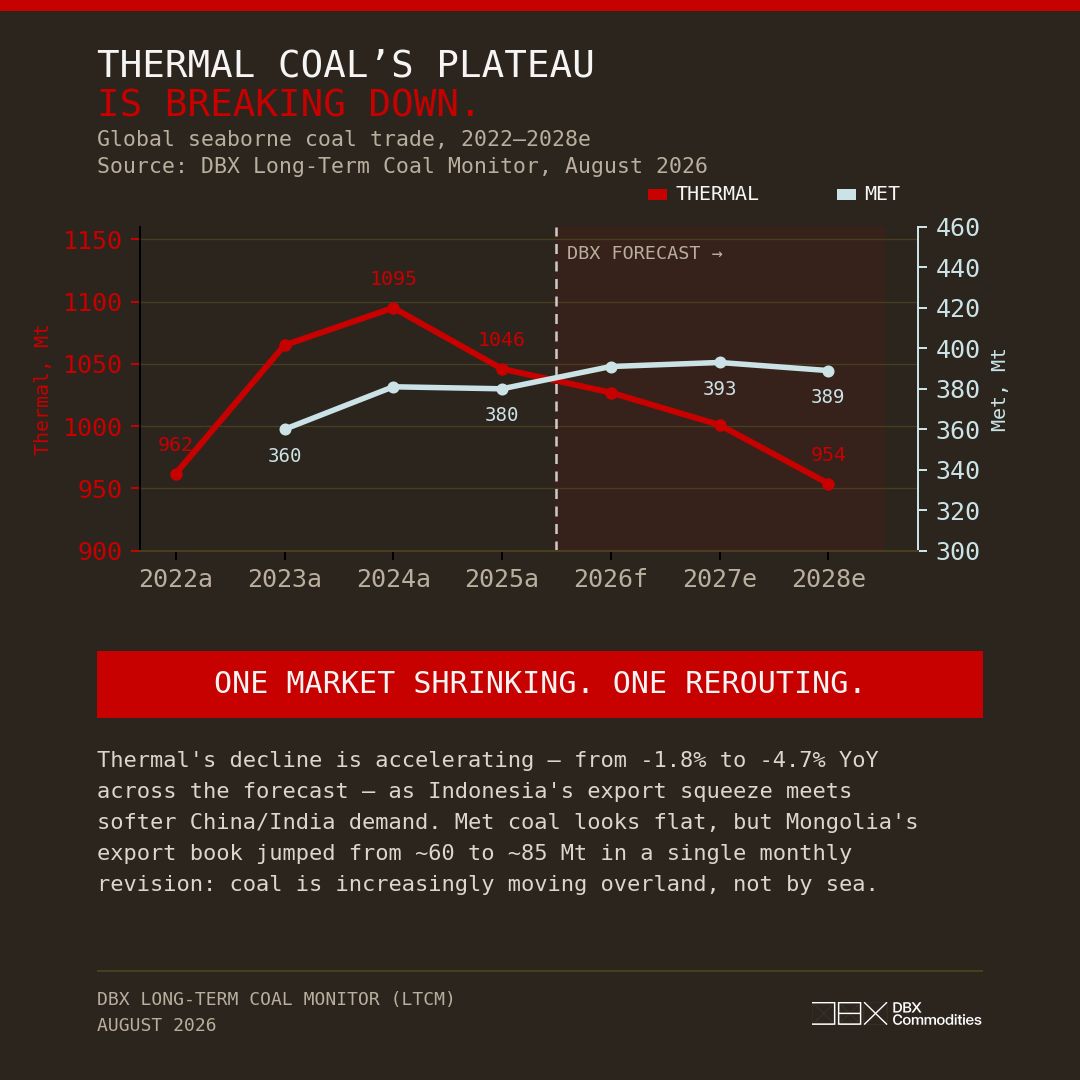
Indonesian 5900 GAR coal exceeded 108 USD/t, while low-calorific 4200 GAR strengthened to 66 USD/t. Continued demand for Indonesian coal from Chinese consumers persists due to tightened safety inspections in China. Demand for mid-CV coal from Vietnam, Bangladesh, and the Philippines remained unchanged. Meanwhile, the availability of Indonesian medium- and high-calorific coal remains limited.
Last week also saw a slowdown in activity as buyers and sellers grappled with the technical aspects of incorporating the state agency controlling exports (DSI) into contracts. This is negatively affecting vessel scheduling and loading. According to a presidential statement, Indonesian mining companies are required to start inputting contracts and transactions into the DSI from June 1, and from September, all sales must be conducted through the state agency.
Supply in Indonesia is also constrained by pending approval of RKAB production quotas, which supports higher prices as producers are unable to confirm shipments.
Australian High-CV 6,000 also jumped, reaching 140 USD/t FOB. Australian coal prices demonstrated an intensifying upward trend amid escalating conflict in the Middle East, rising quotations in Europe, limited availability of Indonesian high-calorific material, and increasing production costs.
Australia’s HCC metallurgical coal index rose to 243 USD/t. Low-volatile PCI quotations strengthened sharply to above 173 USD/t FOB Australia. Prices are supported by limited supply and concerns over shipments in China following the tragedy at the Liushengyu mine in Shanxi province on May 22.
At the same time, market participants note low interest from India, with China remaining the primary driver. According to some estimates, further upside may be limited due to unsold parcels of premium coal totaling several Panamax vessels and low steel prices.
Source: CCA